Welcome to the second edition of the “Old School Game
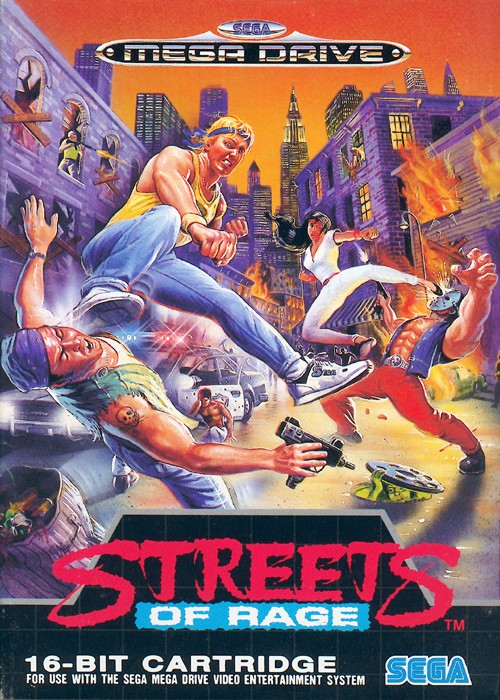
Review”. Last time I covered the classic Sega Mega Drive title, “Streets of
Rage”, and you can read that review here. But while I’m sticking with the Sega
Mega Drive, I’m taking a different route this time. I’m going to review a game
you might not have heard of. This is a game called Speedball 2: Brutal Deluxe.
Not familiar with the “Old School Game Review”? It’s
basically a gift wrapped game review so in theory it’s nothing new. But what is
different is that before I divulge into the review I talk about what makes this
game so good, and some facts and memories the game gave me. Oh and what counts
as an old school game? My ruling is the game has to be at least ten years old.

When did this game come out? 1990
What console was it released on? Sega Mega Drive/Genesis
What else was it released on? Atari ST, Amiga, Amiga CD32,
PC, Commodore 64, NES, Sega Master System, Game Boy, Game Boy Advance.
Compilations? None really.
Other interesting facts? Quite a lot of people who have
played this way weren’t actually sure if there was an original Speedball game.
The original didn’t sell well outside the UK at all despite being well
received. There in fact is a Speedball one although the game was not quite as
good as this sequel. Speedball came out on the Amiga but was also ported to the
NES, the Master System and the PC.
Best memories? I love the fact that I borrowed this game
from a friend, and that friend aside (who I haven’t spoken to for years), I
have yet to hear one person hear of this game personally. I loved taking my
team which was slowly built up through the season, kick some ass and struggle
to win the league with a patched up side. Then if you won the league or won the
playoff, you’d do it all over again but it was even more difficult in the first
division!
Now onto the review!
Speedball 2 is a forgotten relic; a fictional sports game
that’s solid and has more depth to it than most genuine sports games can
capacitate.
Speedball 2: Brutal Deluxe was released in 1990 on the Sega
Mega Drive (or Genesis for you Americans). It’s the official sequel to the
sparsely heard of “Speedball”, which was released a year earlier on the Amiga,
that was well received in the United Kingdom but barely received attention off these
British Isles. Speedball 2 was released on the next generation Mega Drive,
which naturally had improved graphics and the game took advantage of this and
the other components that made it a much more powerful game console.
Speedball 2 is a fictional sports game set in 2105, and
takes place ten years after the beginning of Speedball as a ‘sport’ where there
is violence and chaos everywhere, the game is abandoned to the underground. In
2105, they try to revive the sport and all its vicious and bloody glory. The
game has two divisions of eight teams and you take control of Brutal Deluxe, a
new team on the scene just starting out. Your team is the weakest of the bottom
division and it’s your job to either boost your current squad’s abilities to
compete with the rest of the division, or to replace them with already
established players that are available randomly on transfer.
So what type of sports game is Speedball? Well, in a
nutshell, it’s a mixture of handball, hockey, rugby and football. It’s 9
players against 9, which consist of a goalie, two defenders, three midfielders,
two wingers and a forward. The idea is to throw the ball in the other team’s
goal. Sounds easy, but this is a game where violence is at the essence and is
also rewarded. You can violently tackle other players and punch them, and if a
player gets injured you get the points equivalent of a goal. The best way to
pass the ball around is by throwing it from one player to another, although the
opposition can easily intercept. You can run past players if you’re fast enough
but they can tackle you. It’s a tough game.
 |
| You get points for injuring the opposition. He's bleeding by the way. Brutal. |
Scoring starts at 10 points per goal but there are perks
across the field that affect your scoring. On the two sides of the middle of
the arena are multipliers, putting the ball through it once multiplies scoring
by 150%, a second time will boost it to 200%, totalling at 15 and 20 points per
goal respectively. On the sides of the arena are five stars, one side belongs
to one team and one to the other. If you throw the ball at a star, you get one
fifth of a goal (2 points, boosted to 3 or 4 with multipliers. Getting all five
starts gives you the full equivalent of a goal, and the stars reset. Also note
that if your opposite player throws the ball at your stars, or in the
multipliers, it retracts the last bonus. Near both goals is a green circular
object that each time you hit, gives you one fifth of a goal (once again 2, 3
or 4 points depending on the multiplier) but these points cannot be retracted
unlike the stars and the multipliers. To emphasise the violence of the game,
towards the end walls of the goal are buttons that heat the ball up intensely
and you can throw it at your opposition, scorching them (for some reason it
doesn’t scorch your players, but that logic can be overlooked). Also to
reiterate, you get a goal equivalent of points if you injure an opposition
member, so that can be a tactic if your team is strong enough to break the
opposition down.
So with all these methods and perks to attempt to increase
your score, you simply, have to score more than your opposition to win. But
Speedball is hard. It’s a very hard game, especially as you start as the
weakest team in your division. To make matters worse, you have to score
quickly; the game is two halves of 90 seconds. While Speedball is a hard game
it’s thoroughly enjoyable. I find it a lot more fun to play this game than most
real life sports games. And while it’s violent, it doesn’t do it in a way that
is tasteless, because the game is 2D and is viewed from above the arena; you
see very little of what happens on the field that way.
There are other perks to. Randomly, items will be placed on
the field that can temporarily boost speed or power, give the ball to your
forward instantly, give the ball who got the item instantly, freeze all players
on the spot temporarily, or instantly make all players fall over on the spot.
Lastly, you can find coins that is used to purchase players in the League or
boost your current squad’s abilities.
The main game mode is the league, as explained above. You
start off as the weakest team and can build your players up to be competent,
or, as a quick fix, purchase players on transfer. Either way you have to build
your team to be competent and quickly – if you don’t place in the top two at
the end of the season it’s game over. It’s hard but it’s a great challenge if
you’re willing to take it. To get coin, you have to collect coins that are
randomly placed on the arena floor in the match. I believe there’s a coins
boost for winning matches too, although I’m not too sure about the
technicalities of that. Either way, you find coin on the arena, collect it.
You’ll need it to boost your team. Trust me, you don’t want to try and take on
the league with your team the way it starts. If you get to second place at the
end of the season, which is 14 games (you play all the teams twice, like in
football), you’ll have a playoff match with the team that finished seventh in
the top league. The team placed seventh in the top league is usually a tougher
team that won the league, so it’s a tough match to go through. Winning the
league is the easier route, as you then automatically gain promotion to the top
league. The top league is much harder than the second league, all the teams
play at a high tempo and hit you hard. You’ll once again be the weakest team in
the division, but you’ll have the chance to further boost your squad again and
have access to even better players than you did in the bottom league. You’ll
have to win this league or its game over. Either way, the game ends at the end
of the second season. You can also play the League mode like a manager; watch the games unfold and purchase or build your team up yourself, although this is no where near as fun (and it's much more difficult) as playing the game itself.
 |
| Playing League mode is a lot of fun, this is your starting line up, but you can buy better (and cooler looking) players later on. |
The points structure in the league is quite simple. If you
win a game you get ten points in the league. But you also get bonus points
based on your tally for each match, you get one point for every 10 points scored
in the match. For instance, if you win a match 52-16, you get 10 points for
winning that match, and 5 more points for scoring more than 50 points. The
opposition would get 1 point for scoring more than 10 points in that match. So
basically it’s okay to lose matches, providing that you score a lot of goals.
The top sides in both divisions score loads against the weaker sides, so you
need to be capable of scoring high against these sides to compete as well.
Winning 14 games out of 14 games doesn’t mean you win the league, because that
will give you 140 points, but if you win each game 8-0 rather than 80-0, that’s
a large difference (140 points, where as 14 x 8 is 112, giving you a tally of
252 points, a lot more). So win games and score lots, and you’ll be fine.
Scoring lots and not always winning is also fine, but don’t depend on just
winning.
There are other modes as well. There’s the Cup, which puts
you in two legged matches against random teams from the second division. Other
the course of these two matches you need a better total tally than your
opponent and then you’re through to the next round. You take on three second
division teams and then a team from the top division, usually one of the elite
sides of that division. In these matches you also have to collect coin,
although you can’t purchase players in this competition, meaning you have to
boost your players with the coin you collect on the field. The Cup mode is
okay, but it’s not a very balanced competition; you have three relatively
decent sides and then put against one of the best sides in the game for the
final. You’ll find more balance however, in the Knockout mode. In this mode you
basically take on each side individually in order of difficulty, and if you
lose once you’re out. Once again you cannot purchase players in this game, but
have to boost your original squad with the coin you find. This game is arguably
harder than the cup because of the fact that you’re depending much more on the
coin you find than in the league. But it’s a thoroughly rewarding game mode as
well. Lastly there’s a practise mode, which is not very good, as there’s no
opposition. You take to the field on your own and can pass the ball around and
score in an empty net.
The controls of Speedball are very simple. You only control
one player at a time. All the other players are controlled by AI. If your
player is off screen, you’re in control of another player afterwards. So if
you’re in midfield and the opposition have the ball and start to attack your
defence, you’ll probably start controlling a defender or a goalie. You can
press any of the action buttons (A, B or C) to tackle if you haven’t got the
ball. Once you have the ball, you use the D-pad to move and pressing any of the
actions will throw the ball. You can throw it low or high, a low throw is quick
but easy for an opponent to intercept. A high throw can take out an entire line
of formation if thrown forwards, and your player (or an opposition player) can
catch it on its way down to the ground. So you simply throw the ball to
players, to arena perks or to the goal. If you haven’t got the ball you tackle
the opposition, or if the ball is thrown into the air, try to catch it. As I
said, the controls are very simple and easy to learn, but the game itself is
difficult to master. Also be aware that the arena is closed off, there’s no out
of bounds area and throwing the ball at the wall bounces it back into play and
can be used to your advantage.
For its time, the music, while not having many songs, is
quite good. The songs are basically some techno beats, to emphasise the
futuristic setting of the game. The sounds are also fine, the tacking songs
sound harsh, the throwing of the ball sounds reasonably realistic and because
the players are all wearing metal protection and the walls and floor are metal,
there are a lot of metallic sound effects which all add to the atmosphere
nicely. Also you have an announcer saying “Get ready” after a goal has been
scored, or the start of a new half, which is nice, and when you score you get a
buzzer noise, followed by the same guy saying “Replay!”, and the build up and
goal done in slow motion, which all add to the game. There is a multiplayer
option available on the game, but it’s just a simple match between you and a
friend. You have a certain budget of coin to spend to boost your players’
skills to, and you and your friend can do this in your own ways. Otherwise it’s
just a plain one on one match between you and your friend; there are no league
or cup options or anything like that, which is a shame.
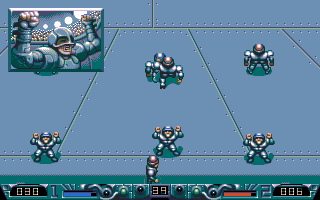 |
| I love the celebration guy. It's the same guy. With the same palette colour. Every time. |
Overall Speedball 2: Brutal Deluxe is an often overlooked
game that deserves more merit than it has. I’m not saying it’s the best sports
game of all time, but I will however say that it’s possibly the best fictional
sport game ever made – there aren’t many of them around and this game does a
solid job of making a fake sport interesting. I always thought that the
premises for Speedball 2 would make a very good film; it has the violence, the
passion, the energy and believability of a real life sport and would make a
fine story to be told on a cinema screen. The game being done in the
underground would also add to the dirty, filthy almost coliseum-like element
the game has.
This is true praise of the game. For a game that came out
over 20 years ago on a console limited in comparison to today’s standards,
Speedball 2 does a lot. It’s frenetic, it’s difficult, it’s a tough game but
it’s more than playable. It’s a great game. It’s such a shame that reboots of
this game have been unsuccessful, it’s not because it’s a bad game (although
the reboots have never touched the quality this game had), it’s because, well,
how do you market a fictional sport? People aren’t interested in these type of
games, not anymore. In the Mega Drive/Genesis era people were interested in
innovation and ‘different’ games, nowadays all people want to do is shoot
stuff. If they like sports games they’ll pick a replica of a real life sport
done on video game. Speedball 2 is lost as a forgotten relic and it’s a damn
shame.
If you have your old Mega Drive/Genesis and have never
played this game and enjoy the sound of it based on this review, seriously, get
it. In the UK at least you can find copies very cheap on Amazon, and I doubt
it’s much different in other countries. The game sold relatively well back 21
years ago, so that’s not an issue. Sustainability is. But if you’re bored, want
to play a retro game that you’ve never played before, give it a go. I implore
you. Because to me, Speedball 2 is a forgotten relic; a fictional sports game
that’s solid and has more depth to it than most genuine sports games can
capacitate, and it simply doesn’t get the credit it deserves.
Rating: ****1/4 stars
For the latest updates on my work, 'like' me on Facebook here!