Showing posts with label sega genesis. Show all posts

Friday, February 03, 2012

Old School Game Reviews: Speedball 2: Brutal Deluxe

Welcome to the second edition of the “Old School Game Review”. Last time I covered the classic Sega Mega Drive title, “Streets of Rage”, and you can read that review here. But while I’m sticking with the Sega Mega Drive, I’m taking a different route this time. I’m going to review a game you might not have heard of. This is a game called Speedball 2: Brutal Deluxe.

Not familiar with the “Old School Game Review”? It’s basically a gift wrapped game review so in theory it’s nothing new. But what is different is that before I divulge into the review I talk about what makes this game so good, and some facts and memories the game gave me. Oh and what counts as an old school game? My ruling is the game has to be at least ten years old.
When did this game come out? 1990
What console was it released on? Sega Mega Drive/Genesis
What else was it released on? Atari ST, Amiga, Amiga CD32, PC, Commodore 64, NES, Sega Master System, Game Boy, Game Boy Advance.
Compilations? None really.
Other interesting facts? Quite a lot of people who have played this way weren’t actually sure if there was an original Speedball game. The original didn’t sell well outside the UK at all despite being well received. There in fact is a Speedball one although the game was not quite as good as this sequel. Speedball came out on the Amiga but was also ported to the NES, the Master System and the PC.
Best memories? I love the fact that I borrowed this game from a friend, and that friend aside (who I haven’t spoken to for years), I have yet to hear one person hear of this game personally. I loved taking my team which was slowly built up through the season, kick some ass and struggle to win the league with a patched up side. Then if you won the league or won the playoff, you’d do it all over again but it was even more difficult in the first division!

Now onto the review!

Speedball 2 is a forgotten relic; a fictional sports game that’s solid and has more depth to it than most genuine sports games can capacitate.

Speedball 2: Brutal Deluxe was released in 1990 on the Sega Mega Drive (or Genesis for you Americans). It’s the official sequel to the sparsely heard of “Speedball”, which was released a year earlier on the Amiga, that was well received in the United Kingdom but barely received attention off these British Isles. Speedball 2 was released on the next generation Mega Drive, which naturally had improved graphics and the game took advantage of this and the other components that made it a much more powerful game console.

Speedball 2 is a fictional sports game set in 2105, and takes place ten years after the beginning of Speedball as a ‘sport’ where there is violence and chaos everywhere, the game is abandoned to the underground. In 2105, they try to revive the sport and all its vicious and bloody glory. The game has two divisions of eight teams and you take control of Brutal Deluxe, a new team on the scene just starting out. Your team is the weakest of the bottom division and it’s your job to either boost your current squad’s abilities to compete with the rest of the division, or to replace them with already established players that are available randomly on transfer.

So what type of sports game is Speedball? Well, in a nutshell, it’s a mixture of handball, hockey, rugby and football. It’s 9 players against 9, which consist of a goalie, two defenders, three midfielders, two wingers and a forward. The idea is to throw the ball in the other team’s goal. Sounds easy, but this is a game where violence is at the essence and is also rewarded. You can violently tackle other players and punch them, and if a player gets injured you get the points equivalent of a goal. The best way to pass the ball around is by throwing it from one player to another, although the opposition can easily intercept. You can run past players if you’re fast enough but they can tackle you. It’s a tough game.
You get points for injuring the opposition. He's bleeding by the way. Brutal.
Scoring starts at 10 points per goal but there are perks across the field that affect your scoring. On the two sides of the middle of the arena are multipliers, putting the ball through it once multiplies scoring by 150%, a second time will boost it to 200%, totalling at 15 and 20 points per goal respectively. On the sides of the arena are five stars, one side belongs to one team and one to the other. If you throw the ball at a star, you get one fifth of a goal (2 points, boosted to 3 or 4 with multipliers. Getting all five starts gives you the full equivalent of a goal, and the stars reset. Also note that if your opposite player throws the ball at your stars, or in the multipliers, it retracts the last bonus. Near both goals is a green circular object that each time you hit, gives you one fifth of a goal (once again 2, 3 or 4 points depending on the multiplier) but these points cannot be retracted unlike the stars and the multipliers. To emphasise the violence of the game, towards the end walls of the goal are buttons that heat the ball up intensely and you can throw it at your opposition, scorching them (for some reason it doesn’t scorch your players, but that logic can be overlooked). Also to reiterate, you get a goal equivalent of points if you injure an opposition member, so that can be a tactic if your team is strong enough to break the opposition down.

So with all these methods and perks to attempt to increase your score, you simply, have to score more than your opposition to win. But Speedball is hard. It’s a very hard game, especially as you start as the weakest team in your division. To make matters worse, you have to score quickly; the game is two halves of 90 seconds. While Speedball is a hard game it’s thoroughly enjoyable. I find it a lot more fun to play this game than most real life sports games. And while it’s violent, it doesn’t do it in a way that is tasteless, because the game is 2D and is viewed from above the arena; you see very little of what happens on the field that way.

There are other perks to. Randomly, items will be placed on the field that can temporarily boost speed or power, give the ball to your forward instantly, give the ball who got the item instantly, freeze all players on the spot temporarily, or instantly make all players fall over on the spot. Lastly, you can find coins that is used to purchase players in the League or boost your current squad’s abilities.

The main game mode is the league, as explained above. You start off as the weakest team and can build your players up to be competent, or, as a quick fix, purchase players on transfer. Either way you have to build your team to be competent and quickly – if you don’t place in the top two at the end of the season it’s game over. It’s hard but it’s a great challenge if you’re willing to take it. To get coin, you have to collect coins that are randomly placed on the arena floor in the match. I believe there’s a coins boost for winning matches too, although I’m not too sure about the technicalities of that. Either way, you find coin on the arena, collect it. You’ll need it to boost your team. Trust me, you don’t want to try and take on the league with your team the way it starts. If you get to second place at the end of the season, which is 14 games (you play all the teams twice, like in football), you’ll have a playoff match with the team that finished seventh in the top league. The team placed seventh in the top league is usually a tougher team that won the league, so it’s a tough match to go through. Winning the league is the easier route, as you then automatically gain promotion to the top league. The top league is much harder than the second league, all the teams play at a high tempo and hit you hard. You’ll once again be the weakest team in the division, but you’ll have the chance to further boost your squad again and have access to even better players than you did in the bottom league. You’ll have to win this league or its game over. Either way, the game ends at the end of the second season. You can also play the League mode like a manager; watch the games unfold and purchase or build your team up yourself, although this is no where near as fun (and it's much more difficult) as playing the game itself.
Playing League mode is a lot of fun, this is your starting line up, but you can buy better (and cooler looking) players later on.
The points structure in the league is quite simple. If you win a game you get ten points in the league. But you also get bonus points based on your tally for each match, you get one point for every 10 points scored in the match. For instance, if you win a match 52-16, you get 10 points for winning that match, and 5 more points for scoring more than 50 points. The opposition would get 1 point for scoring more than 10 points in that match. So basically it’s okay to lose matches, providing that you score a lot of goals. The top sides in both divisions score loads against the weaker sides, so you need to be capable of scoring high against these sides to compete as well. Winning 14 games out of 14 games doesn’t mean you win the league, because that will give you 140 points, but if you win each game 8-0 rather than 80-0, that’s a large difference (140 points, where as 14 x 8 is 112, giving you a tally of 252 points, a lot more). So win games and score lots, and you’ll be fine. Scoring lots and not always winning is also fine, but don’t depend on just winning.

There are other modes as well. There’s the Cup, which puts you in two legged matches against random teams from the second division. Other the course of these two matches you need a better total tally than your opponent and then you’re through to the next round. You take on three second division teams and then a team from the top division, usually one of the elite sides of that division. In these matches you also have to collect coin, although you can’t purchase players in this competition, meaning you have to boost your players with the coin you collect on the field. The Cup mode is okay, but it’s not a very balanced competition; you have three relatively decent sides and then put against one of the best sides in the game for the final. You’ll find more balance however, in the Knockout mode. In this mode you basically take on each side individually in order of difficulty, and if you lose once you’re out. Once again you cannot purchase players in this game, but have to boost your original squad with the coin you find. This game is arguably harder than the cup because of the fact that you’re depending much more on the coin you find than in the league. But it’s a thoroughly rewarding game mode as well. Lastly there’s a practise mode, which is not very good, as there’s no opposition. You take to the field on your own and can pass the ball around and score in an empty net.

The controls of Speedball are very simple. You only control one player at a time. All the other players are controlled by AI. If your player is off screen, you’re in control of another player afterwards. So if you’re in midfield and the opposition have the ball and start to attack your defence, you’ll probably start controlling a defender or a goalie. You can press any of the action buttons (A, B or C) to tackle if you haven’t got the ball. Once you have the ball, you use the D-pad to move and pressing any of the actions will throw the ball. You can throw it low or high, a low throw is quick but easy for an opponent to intercept. A high throw can take out an entire line of formation if thrown forwards, and your player (or an opposition player) can catch it on its way down to the ground. So you simply throw the ball to players, to arena perks or to the goal. If you haven’t got the ball you tackle the opposition, or if the ball is thrown into the air, try to catch it. As I said, the controls are very simple and easy to learn, but the game itself is difficult to master. Also be aware that the arena is closed off, there’s no out of bounds area and throwing the ball at the wall bounces it back into play and can be used to your advantage.

For its time, the music, while not having many songs, is quite good. The songs are basically some techno beats, to emphasise the futuristic setting of the game. The sounds are also fine, the tacking songs sound harsh, the throwing of the ball sounds reasonably realistic and because the players are all wearing metal protection and the walls and floor are metal, there are a lot of metallic sound effects which all add to the atmosphere nicely. Also you have an announcer saying “Get ready” after a goal has been scored, or the start of a new half, which is nice, and when you score you get a buzzer noise, followed by the same guy saying “Replay!”, and the build up and goal done in slow motion, which all add to the game. There is a multiplayer option available on the game, but it’s just a simple match between you and a friend. You have a certain budget of coin to spend to boost your players’ skills to, and you and your friend can do this in your own ways. Otherwise it’s just a plain one on one match between you and your friend; there are no league or cup options or anything like that, which is a shame.
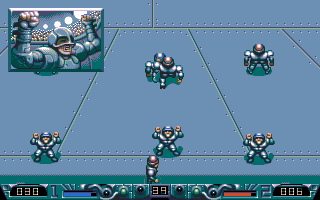
I love the celebration guy. It's the same guy. With the same palette colour. Every time.
Overall Speedball 2: Brutal Deluxe is an often overlooked game that deserves more merit than it has. I’m not saying it’s the best sports game of all time, but I will however say that it’s possibly the best fictional sport game ever made – there aren’t many of them around and this game does a solid job of making a fake sport interesting. I always thought that the premises for Speedball 2 would make a very good film; it has the violence, the passion, the energy and believability of a real life sport and would make a fine story to be told on a cinema screen. The game being done in the underground would also add to the dirty, filthy almost coliseum-like element the game has.

This is true praise of the game. For a game that came out over 20 years ago on a console limited in comparison to today’s standards, Speedball 2 does a lot. It’s frenetic, it’s difficult, it’s a tough game but it’s more than playable. It’s a great game. It’s such a shame that reboots of this game have been unsuccessful, it’s not because it’s a bad game (although the reboots have never touched the quality this game had), it’s because, well, how do you market a fictional sport? People aren’t interested in these type of games, not anymore. In the Mega Drive/Genesis era people were interested in innovation and ‘different’ games, nowadays all people want to do is shoot stuff. If they like sports games they’ll pick a replica of a real life sport done on video game. Speedball 2 is lost as a forgotten relic and it’s a damn shame.

If you have your old Mega Drive/Genesis and have never played this game and enjoy the sound of it based on this review, seriously, get it. In the UK at least you can find copies very cheap on Amazon, and I doubt it’s much different in other countries. The game sold relatively well back 21 years ago, so that’s not an issue. Sustainability is. But if you’re bored, want to play a retro game that you’ve never played before, give it a go. I implore you. Because to me, Speedball 2 is a forgotten relic; a fictional sports game that’s solid and has more depth to it than most genuine sports games can capacitate, and it simply doesn’t get the credit it deserves.

Rating: ****1/4 stars


For the latest updates on my work, 'like' me on Facebook here!


Wednesday, December 14, 2011

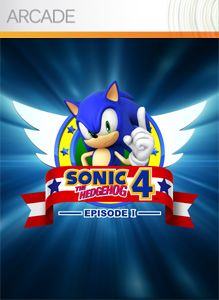
Game Review: Sonic the Hedgehog 4: Episode I


Sonic 4: Episode I is a great, yet not spectacular sequel, 16 years overdue that should appeal enough to new and old fans alike.


Sonic 4: Episode I was released back in October 2010 on multiple platforms including the Xbox 360 Live Arcade, Nintendo Wii, and the Playstation 3. It’s considered the direct sequel so “Sonic 3 and Knuckles” the two games released in 1994 on the Sega Mega Drive and Genesis, marking a sixteen year gap between the two sets of games.

Now unless you’ve been living under a rock chances are high that you know that many MANY Sonic games have been released in the sixteen years between these games. But a lot of fans of the Sonic games lost interest and disliked the direction that Sonic took after the release of the classic Sonic titles. Sonic 3D back in 1996 was received poorly, and while Sonic Adventure, which was released on the Sega Dreamcast in 1998, was received quite well, a lot of the older fans didn’t like the change in style that Sega were adamant on keeping. The newer Sonic titles were in full 3D and still concentrate on his speed but in the 3D environment the controls are very poor when in relation to the speed they were setting. Sonic Adventure 2 was then released three years later in 2001 and was also relatively well received by newer fans, but disliked by fans of old. The gameplay was changing even more with the release of Sonic Heroes in 2003 on the Nintendo Dreamcast, Xbox and Playstation 2, with the multiplayer aspects and the idea that you control more than one character at a time, but once again the game was well received by newer fans, and disliked by the classic fans.

There has been a big debate about the Sonic series since 1994 as you can tell. The reception of most games were mixed to positive by newer fans but mixed to negative by older fans. Sega wanted to keep up with the times and move forward with a 3D hungry video gaming world. They had mixed results doing this. But the all time low for Sonic was the release of “Sonic the Hedgehog” in 2006, released on the Xbox 360 and Playstation 3. This move was bold as Sega were attempting to use the “Sonic the Hedgehog” title again rather than move to spinoff titles. It was seen as a series redesign and an attempt to appeal to both new and old fans alike. The game was received extremely negatively, by both new and old fans for its poor controls and its attempt to make the plot deeper with an awful storyline. It’s to some considered one of the worst games ever made. After this release a lot of fans really started to turn on the Sonic series, as it had been such a long time since a truly great Sonic game was released. Despite the Sonic Adventure series receiving decent reviews, there was no true gem in the Sonic series since the Sega Mega Drive/Genesis days. They then released Sonic Unleashed in 2008 on the Playstation 2 and 3, the Wii and the Xbox 360. It merged some new gameplay with some old school game 2D gameplay from the 16-bit era and the game was warmly received by both sets of fans.

Then, one year later, it was revealed that Sega were to finally make a game directly targeted to appeal to old school games. The game would be fully 2D and would bring the gameplay back to its older days. The music would be reminiscent of the music in the older games and some of the enemies from these games would make returns. It was also decided that the only character available in the game would be Sonic the Hedgehog himself. The game, once again quite boldly, was to be called Sonic the Hedgehog 4. A lot of fans immediately thought back to “Sonic the Hedgehog” back in 2006, a move that was a failure to bring back some of the old fans. Was labelling this new game “Sonic 4” to be a success, or a failure?

Sonic the Hedgehog 4: Episode I brings the plot back to 1994 and take place straight after the events of “Sonic 3 and Knuckles”; Dr Robotnik (NOT Dr Eggman, I refuse to use that name in this review again) has been defeated and his space station is destroyed. Sonic takes a break away from his friend Tails and his new companion Knuckles and goes to explore new places on his own. Little does he know that Dr Robotnik has returned and he has reconstructed some of his own old creations to make them bigger and badder than before, and to stop Sonic once and for all.
He must have stolen something really valuable if he's running THAT quickly.
The gameplay for Sonic 4 does indeed return to its roots; it’s the simple 2D terrain and Sonic runs forward with the press of the D-pad or analog stick. He can jump on enemies and boxes, and the Spin Dash, first featured in “Sonic the Hedgehog 2” returns. The Spin Dash is done by pressing the D-pad downwards and pressing the jump button multiple times, and allows Sonic to roll on the ground at a high speed. The game has returned to its roots, but the major addition to gameplay in “Sonic 4” is the addition of the Homing Attack; when Sonic is mid-air a target may appear on an enemy, a bumper or a box, and by pressing the jump button again, Sonic immediately homes into his target at high speed. This however is a welcome addition to the old school gameplay as it gives the title its own flavour and separates the game slightly from its predecessors. Older fans think this too; not all change is bad after all.

The levels look fantastic in Sonic 4. There are five levels, four of them have two acts and a boss battle and the fifth level is a large final boss battle with multiple stages. The graphics for Sonic 4 are smooth and colourful and look even better in HD. Despite times changing in the past 16 years and there being more and more emphasis on 3D games now, these 2D graphics are just excellent. Sonic games have always been vivid and lively in its colour palettes and this is no different, it’s just done stronger now than ever before. The five levels are all homage and tweaks to levels in the original Sonic titles; first you have “Splash Hill Zone”, which is homage to “Green Hill Zone” from the original “Sonic the Hedgehog” game, then you have “Casino Street Zone” which pays tribute to “Casino Night Zone” from “Sonic the Hedgehog 2”, “Lost Labyrinth Zone” has many elements from the original “Labyrinth Zone” from “Sonic 1”, and “Mad Gear Zone” has a very similar design to “Metropolis Zone” from “Sonic 2”. The final boss level, which is only unlocked if you beat all four zones and their respective boss levels, is the “E.G.G. Station Zone“, which combines many elements from the previous four boss levels while adding a new final boss, one that is very similar to the final boss from “Death Egg Zone” from “Sonic 2”. All of these tributes are more than welcome additions to the game, the only problem otherwise being that some of the levels and designs can be argued to take too much from the original game series, but it is of my personal opinion that there’s enough originality and tweaking here to see it as homage rather than recycling old materials.

I said earlier that you have to beat all four zones and their boss battles to unlock the fifth and final zone. However one major change to Sonic 4 that was not done in the original series is the flexibility of completing your acts and boss battles in any order you wish. When you load up Sonic 4, you must complete Act 1 of “Splash Hill Zone”, after that however you have access to a screen that you can select any of the four zones in any order. If you beat Act 1 of that level, then the second act opens up, then the third if you compete the second, and then the boss battle when you finish the third. But by all means go straight to “Mad Gear Zone” once you have access to this screen if you wish. My feelings on this are mixed, as I loved the idea of you going through the levels in order of events as it made you feel like you were following Sonic on his amazing adventure like a story. However with the times completely changed from the way things were 16 years ago you can understand why Sega have decided to give you access to nearly everything from the get go; we live in a generation where we are impatient and want to do things straight away, rather than unlock our rewards with hard work. Another addition naturally are the leaderboards, where you can compare your time and point tallies to other people who have played the game across the world.

There are other elements from the original series that remain in Sonic 4. You still have to jump on enemies or spin into them to defeat them. You still have to pick up rings, and if you get hit by an enemy you lose all of those rings. If you have no rings and get hit you lose a life. The boxes you can jump on still contain 10 rings, an extra life, running shoes to make you run even faster, temporary invincibility and a shield. Unlike “Sonic 3 and Knuckles” however there is only one shield, similar to “Sonic 1” and “Sonic 2”. A shield lets you take one more hit from an enemy, giving you extra protection and saves you from losing your rings. One thing that is different however is that there are no continues in Sonic 4. Once again the idea of having continues is silly in a modern gaming environment so it simply doesn’t need to exist.
He must have stolen something really valuable if they are releasing giant BALLS at him!
When you finish an act, like “Sonic 1”, if you have more than 50 rings you will see a large ring that Sonic can jump into, leading to a Special Stage. These Special Stages are too, reminiscent of the ones that were added in “Sonic 1”, where you have to guide Sonic through a puzzled level full of bright lights and rings, to the end where a Chaos Emerald will lie. The big difference between these Special Stages and the ones in “Sonic 1” is that you control the level in this game, and you must move the level rather than Sonic to get him to go in the right directions to the end, where as in “Sonic 1” you controlled Sonic and made him move and jump through the stage. If you collect all 7 Chaos Emeralds, you will have access to Super Sonic, golden, faster and invincible version of himself, like in Sonic 2, 3 and Knuckles. To activate him, you must first accumulate 50 rings, and as he is set off, your rings deplete by one per second, and if you run out, you’ll revert back to normal Sonic. Super Sonic is another great welcome in the series, and the times and points tallies on the leaderboards separate between just Sonic, and levels where Sonic and Super Sonic where used, so it’s good fun.

The music in this game is indeed reminiscent of the music found in the games released on the Mega Drive. It’s still crisp and clear enough to tell that it’s got a tinge of modernisation, but the move is certainly welcome, and the music immediately brings you back to the days when the music was so good. A lot of the newer Sonic games try to incorporate rock and metal music rather than the soft dance/techno sounds found in the games released in the early nineties. The sounds are also pretty much exactly the same as the classic games, with Sonic’s jump noise, the collection of rings, opening of boxes and spin dash all sounding as great as it did back in the day.

The main problem with Sonic 4: Episode I for me is the controls when it comes to high speed movement, something that has always been a problem with modern Sonic games. Sonic moves very fast as he always does, and in the older games released 16 years ago and prior, the gravity defying movement was controlled perfectly, with very few hitches. While this game for large parts deals with the pace and the movement of Sonic well, there are times when Sonic stops, or hits the end of a wall. These situations are quite irritating as some of the finest memories of Sonic are when he’s in motion, running or rolling across a terrain with ease and grace, and for a glitch or a wall to be hit in a way that the game doesn’t like unexpectedly, brings the motion to an abrupt halt. Another thing is that Sega have also made Sonic fall with good poise on some occasions rather than him fall in a ball movement like he used to. Sonic will look downwards at the ground below and in this stance he is vulnerable to attacks, where as when he is rolling downwards from the sky he is in an attacking stance, and will land on his enemy crushing it. This can catch you out at times when you want to attack certain enemies below you as you’ll lose your rings if he is not in his rolling attacking stance, and there seems to be no consistency with it.

Another problem that was once raised was the length of the game. The game has three acts and a boss level for four zones before the final boss. Tally that up and you have 17 levels in total. Considering when the game came out it was 1200 Gamerpoints on the 360, around £7 on the Playstation 3 and 1500 Wii Points, which are considered steep prices for the “arcade/downloadable” stream of gaming available, it’s still pretty cheap. These games cost anything from £30 to £50 when they were individually released back in the early nineties, so complaining about the price is silly. Remember that “Sonic 1” had six zones of three acts, totalling 18, and “Sonic 3” had even less; six zones of two acts, totalling 12, so this isn’t a bad deal. Not only that, but the games have since been reduced in price on both the 360 and PS3.
The special stages are as difficult and trippy as they ever were.
The most important question in this review simply is, does the game live up to the expectations and hype? Will the old school fans be happy? Overall, I think the answer is yes. Sonic 4 does a great job in bringing nostalgia and homage to the old series while doing just enough to clarify its position as an individual title released sixteen years later. Sonic 4 is a fine, if not extravagant effort that should bring old and new fans together to appreciate what was so amazing about the series in the early nineties. The music, the level design, the enemy design and most importantly, the 2D design are all reminiscent of the classic games yet the Homing Attack, the new level select menu, and the leaderboards all serve reminders that this is the 21st century; a game released in 2010 not 1994. And the game does a good job of balancing elements from both worlds, and, both sets of fans, old and new. Overall, Sonic 4: Episode I is a great, yet not spectacular sequel, 16 years overdue that should appeal enough to new and old fans alike. There is room for improvement, and I hope that Sonic 4: Episode II will deliver that promise.

Rating: **** stars


For the latest updates on my work, 'like' me on Facebook here!


Saturday, December 03, 2011

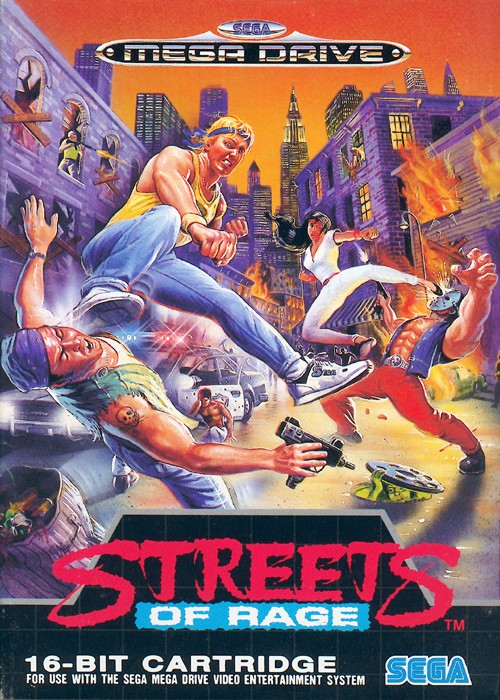
Old School Game Reviews: Streets of Rage

Welcome to a new section of the website called the “Old School Game Review”. Now this is basically a gift wrapped game review so in theory it’s nothing new, but what is different is that before I divulge into the review I’m going to talk about what makes this game so good, and some facts and memories the game gave me. Oh and what counts as an old school game? My ruling is the game has to be at least ten years old. So the inaugural “Old School Game Review” is the classic, Streets of Rage.

When did this game come out? August 1991
What console was it released on? Sega Mega Drive/Genesis
What else was it released on? Sega Game Gear, Sega CD, Sega Master System, Nintendo Wii, iPhone
Compilations? It’s appeared on “Mega Games II”, “Sega Genesis/Mega Drive 6-Pak” and “Mega 6” for the Sega Mega Drive/Genesis, “Sega Classics Arcade Collection” for the Sega Mega CD and the “Sega Mega Drive Ultimate Collection” on the Xbox 360 and Playstation 3 (which I reviewed here)
Other interesting facts? It’s considered the spiritual successor to the “Golden Axe” series. Its spiritual successor is considered “Fighting Force”, which didn’t sell well and flopped on the Playstation and Nintendo 64. After Streets of Rage III, no other game in the series has officially been made.
Why review this game? It’s probably the first multiplayer I absolutely fell in love with. It was one of the first games I ever played on the Sega Mega Drive, as part of the “Mega 6” mentioned earlier. I have some absolutely golden memories playing this with my two sisters when I was a wee child.
Best memories? I remember the first time got to Mr X with my sister and we chose different options to join his syndicate. If you didn’t know, if you play two-player and get to this stage and choose different options, you get the bad ending. You then have to fight each other and the survivor gets the option again, if you choose not to join the syndicate, it doesn’t matter, it gives you the bad ending regardless. The first time I got the bad ending, with the horrible ending music and the sprite of your character sitting in the chair looking into your soul from the TV gave me chills. Of course, that and beating the crap into your sister on games was always fun and there was a lot of doing that I promise you!

Now onto the review!

Streets of Rage packs a mighty punch as a game on top of its generation.

Streets of Rage was released in August 1991, making it twenty years old. Two years earlier Sega had released Golden Axe; a side-scrolling beat ‘em up that was set in a medieval fantasy land with monsters and warriors. While the game was successful, there was an idea to have a similar game in a modern setting. That’s where Streets of Rage came in.

The game is set in a high-energy city that was once nice and peaceful, but has recently fell under the control of a criminal syndicate. The damage and effect on the city was so big even the police had their hands tied. Violence and crime was rife and no one could do anything there. Three police officers try to take control on an attack in the city. But the police didn’t want a special unit to disrupt the syndicate’s activities. In disgust, they hand their badges in and decide to take matters into their own hands. On their own, the three ex-police officers, with brute force and firsts, take on the syndicate to bring the city’s control back to the people.

The three ex-police officers are the three characters available for choice in the game. They all vary in fighting style, jump abilty and speed. First there’s Adam, who’s got a boxing background and is the strongest character in the game and can jump well. To compensate, he’s also the slowest. There’s then Blaze, who has a judo background, who is the quickest character but compensates it for being the weakest. Axel is the third character with a martial arts background, and is of medium strength and speed, but is a poor jumper. All three characters are useful in different ways and are very well balanced.
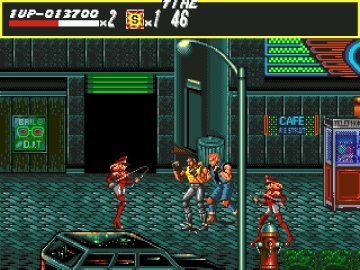
This is some party.
The game’s controls are simple. Moving with the D-pad, you simply press one of the eight directions you wish your character to move to and they will move on the terrain in the direction you choose. You press “B” to attack an enemy in front of you, and rapidly to do a combo. If you walk towards your enemy and latch onto them, you can apply a grappling body attack. If you grab them from behind you can suplex them backwards. To jump you press the “C” button, and combine it with either moving left or right to jump in either direction. Combining a jump and an attack is also simple, press “C” to jump and then “B” to kick them mid-air. If you press the “C” button when you have hold of an enemy, you can jump over them, either forwards to backwards or vice versa, to suplex them or pummel them, depending what way you’re facing them. If you are grappling them, pressing the “B” button and the opposite direction to which you are facing to throw them behind you, possibly throwing them into multiple enemies.

As well as melee attacks you can also use weapons. To pick up weapons simply press the “B” button when directly above one. Weapons vary from baseball bats to knives and vary in use; bats can reach enemies from further away but knives can be thrown.

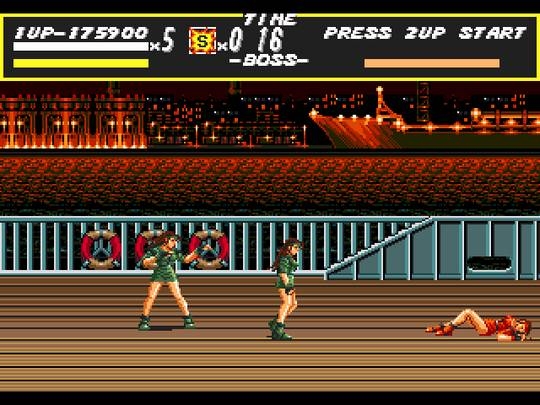
That leaves one button on the Sega Mega Drive controller, which is the “A” button. This is your special attack, one that you get automatically per life you have, or you can pick them up on a very rare occasion otherwise. Your special attack calls on a secret member of the police force who is discretely supporting the three ex-cops, and shoots from afar; either with a large missile launcher or a heavy duty machine gun. Both of these actions do the same thing, which is basically wiping the screen completely of enemies. The exception is the bosses, and instead it takes a chunk of their health.
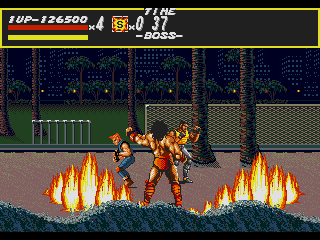
This is an even better party!
Streets of Rage has eight levels, which you progress from left to right in typical side-scrolling fashion. There are different enemies on route, with different levels of health and difficulty. Also on your way are breakable items, for instance, the first level is the street, and here you can find telephone boxes to break. On the fourth level is a bridge, and you can find cones lying around which you can break. In these items are different things, either apples or steaks that give you a health increase, the former less than the latter that brings your health to the max. There’s also bags of cash, other weapons, and on rare occasions, extra lives or extra uses of your special. After side scrolling to the end of the level a boss will appear. These bosses are large in size and pack a punch. Bosses have their own fighting style and increase in difficulty as you progress through the game. On some of the later levels you may have to fight bosses multiple times throughout the level.

The one thing that has always stood out about Streets of Rage is the fantastic soundtrack. Every level has its own track that fits perfectly with its design and the boss music is absolutely brilliant too. All the games in the Streets of Rage series has good music but for me personally neither sequel has beat the first for quality. Aside from the music, the sound is as good as any Mega Drive title; the enemies give out cries when they are defeated and the sounds that are made when you attack and are attacked are different. I wouldn’t say it’s realistic, I mean this was 1991, but the idea is there and it sounds good enough.
...the party is not so fun anymore.
To finalise, Streets of Rage is one of the best games of its generation. Yes the second game improved on the foundations this game set, but back in 1991 there was nothing better than this. Streets of Rage still brings great satisfaction and enjoyment today, in a time were complexity and graphics are considered favourable. The game is great if you’re playing on your own and takes around an hour to complete, but it’s even better with a friend. If you’ve never played this game before, you’re missing out, get a copy, you can find it quite cheap in many different places. Or get the “Sega Mega Drive Ultimate Collection”, which features this and the other two titles in the series, amongst its 40+ game collection, which you can find for less than £15 in some places. Streets of Rage packs a mighty punch as a game on top of its generation.

Rating: ****1/2 stars


For the latest updates on my work, 'like' me on Facebook here!


Monday, November 07, 2011

Game Review: Sega Mega Drive Ultimate Collection

With popular classics and a few hidden gems, the “Sega Mega Drive Ultimate Collection” is as good a compilation of 40+ games you’ll ever see.

The Sega Mega Drive Ultimate Collection was released back in February 2009, nearly two years ago, for both the Xbox 360 and the Playstation 3 and advertises 40 classic Mega Drive (or Sega Genesis, for those elsewhere in the world) titles all on one disc and for the first time, the games are compatible in HD.  It’s one of the biggest collections of video games on one bit of media available, and it contains some of the biggest and best games that were released on the fourth generation console. Also included are some unlockable games from either the Sega Master System or the arcade.

So what games are available on this compilation? How about all the main “Sonic the Hedgehog” titles, which are Sonic 1, 2, 3, “Sonic and Knuckles”, 3D and Spinball? It also has “Streets of Rage” 1, 2 and 3, “Phantasy Star” II, III and IV, “Golden Axe” I, II and III, the two “Ecco the Dolphin” titles, “Shining Force” I and II and “Vectorman” 1 and 2 amongst others. These games, back in the day, were anything from £20 to £50 each, and considering the game was £25 upon release and available now from £10 to £15. I’m pretty good at Maths and this spells out at up to £2000 in games back in the day, and all together it’s now available for anything up to 200 times less. That’s an immense statistic. There are other great games on this list too, like “Alex Kidd in the Enchanted Castle”, “Altered Beast”, “Columns”, “Dr. Robotnik's Mean Bean Machine”, “Flicky”, “Gain Ground” and “Shinobi III: Return of the Ninja Master”. I don’t really know if I really need to review this game because simply listing all of these amazing games says it all, but I’ll continue.
It's great to see such classic titles again, crisper than ever.
Having all the classic “Sonic the Hedgehog” titles in one game isn’t a new thing, it’s been done many times before, but it’s still a great way to play these games again, or for the first time if you’re too young to have played the games when they were released. The best thing about these Sonic titles, which are now up to 20 years old (Happy Anniversary Sonic!) are that the graphics still look absolutely beautiful today, with it’s amazing palette of colours and the fast action. The tightening of the graphics to HD level doesn’t make the biggest of differences but it’s a more than welcome addition.

One of the main bad points about this compilation is that it doesn’t include the “lock-on” Sonic games. Just in case you’re not familiar, the Mega Drive cartridge for “Sonic and Knuckles” had an innovative “lock-on” section at the top where you can attach a second cartridge to it. This was so you could attach another Sonic title to it; if you attached “Sonic the Hedgehog 3” to it, a game that does not feature the Knuckles as a playable character, allows you to now do so. It also allows you to play through the “Sonic 3” levels and then the “Sonic and Knuckles” levels, giving you a whopping fourteen levels of gameplay. I always maintain that these two games combined a game that’s often called “Sonic 3 and Knuckles”, is the most complete version of Sonic the Hedgehog ever. The “lock-on” feature also gave you access to “Sonic 2 and Knuckles” and the original “Sonic the Hedgehog” title locked onto “Sonic and Knuckles” gave you access to hundreds of random bonus stages that are similar to those available on “Sonic the Hedgehog 3” and “Sonic and Knuckles”. So no “lock-on” features is a major downer for me personally, and many other fans as well, due to these versions of the games being so good in the original formats. The producer of this compilation said that there were “tight development times” for the release of this game and that’s the reason they’re not included. They said that if they were to release these “lock-on” games there would be no room for other games, like the bonus “Master System” games. It’s a fair point, although personally I would have preferred the “lock-on” versions over the old Master System and arcade games. But you also have to consider, we have six Sonic titles on this compilation already, so there’s enough Sonic content on here for other games to be considered, which is fair enough.
Riding dragons in Golden Axe was so much fun, now you can do it again!
There are so many games for you to choose from in this compilation, and they cover a lot of different genres here too. Sonic, naturally is a platformer, and that along with other games like “Alex Kidd”, “Dynamite Headdy” and “Shinobi III” will keep you going in a variety of different ways. For the RPG fans you can’t look any further than the “Shining Force” series, a turn based RPG that’s as good turn based RPG ever. The “Shining Force” series stands out as some of the best RPG games ever, and most certainly on the Mega Drive, a console lacking in good quality RPGs. The three “Phantasy Star” games are also well received RPG games that are available, so you have hours and hours of fantasy role playing games to sink your teeth into here. For the side scrolling beat-em-ups, the “Streets of Rage” series set the standard and has arguably never been beat for them. The “Streets of Rage” series, the trilogy, vary in difficulty and have great looking sprites, a range of characters and some funky music, some of the best music available on the Mega Drive. Other alternative side scrollers are the “Golden Axe” series, which are all very similar in style but still are very enjoyable, the very retro “Altered Beast”, a game that has dated a little since the early nineties but is still a little but of fun to play, and is slightly harder than the other games in the genre. There are other games in other genres too, too many to put into great detail here and are all worth a look.

I told you earlier, if you bought these games back when they came out, your total bill could have possibly reached £2000 so you definitely have a vasts amount of content here. There are some popular classics here, but there are also some games here that you may have not played, and that’s a good thing. There’s a justifiable reason for each of the 40+ games to be included here. There’s the obvious, Sonic and “Streets of Rage”, but there’s the more subtle, less popular games here that are of good quality yet their lack of popularity made them almost forgotten. Take “Gain Ground” for example, my favourite game from the few games I had never played before, it’s really good. “Gain Ground” is an odd arcade strategy-shooter, where you simply have go through all the levels and beat the game. In more depth, you can either get through each level by getting your characters individually to the other side of the screen, or kill all the enemies on the screen for automatic progress. As you go through the game you can save and recruit your hostages, all which are trapped warriors and can aid you in battle. It’s easier to play this game than explain it, and it’s a lot of fun, especially as each warrior has their own ways of attacking enemies with their own weapons and special abilities. If you get this compilation give this game a go if you’ve never played it before, it’s an interesting little game that doesn’t have much recognition as a great quality game from the Mega Drive days. Another decent effort is “Ristar”, a game released in 1995 when the Mega Drive was in its dying days, which was made by the same team that made Sonic. Give that a go as well as it deserves more recognition than it has. As I said though, it’s hard to do mini reviews of all the games available on here, but if I were to choose two ‘not-so-popular’ games on the compilation to play, these two are the ones I’d choose.
Shinobi III is still so much fun all these years later.
So all in all this is a fantastic compilation. I’m not going to claim that you’ll love all the 40+ games on this CD, you won’t. But there’s something here for everyone, and chances are there are games on this disc that you’ve never played before. Seriously, give the new games a go. You might find a hidden gem or two. It’s hard to rate compilations due to the fact that not every game on these things are going to be to your taste. But as homage to one of the best video game consoles of all time and the great games that came out on it, the “Sega Mega Drive Ultimate Collection” is as good a compilation of 40+ games you’ll ever see.

Rating: ****1/4 stars

For the latest updates on my work, 'like' me on Facebook here!