Showing posts with label xbox 360. Show all posts

Wednesday, June 27, 2012

The Mercy Side: Youth and Young Manhood

Here's a short article from me today. I just want to get a few things off my chest.

So I bought a game last week. A game I hadn't played in a very long time. A game that is terribly dated, and even at the time it was poorly designed. That game is called 'Championship Manager 2007'.

Why did I buy 'Championship Manager 2007'? Well, the Championship Manager series, like most football manager games, are mainly released on the PC, where as I used to have it on the Playstation 2, but wanted it for my XBox 360 as I'm trying to move as many games as I can from my old console(s) to my current one. And this was the last year they released a Championship Manager game onto a console. 2008 onwards have solely been released on the PC. So I'm stuck with a game that's six years out of date.

Six years in football is a very long time. As you may know I support Liverpool. What players did Liverpool have in that season? Rafa Benitez was in charge, and we had the likes of Peter Crouch, Robbie Fowler, Sami Hyypia and John Arne Riise at the club. We even had Stephen Warnock and Darren Potter, remember those youth players that have found better success elsewhere? Ah yes. Football goes so quickly we all get sucked into it and forget how fast time can go. Six years ago was before we got to a second Champions League final, got new owners, got rid of new owners and got new NEW owners, got 2nd place in the Premier League, won a Carling Cup, went through three managers in two seasons, bought Fernando Torres, sold Fernando Torres and spent a whopping £35 million on Andy Carroll. Six years really is a very long time.

But... in real life, six years is nothing. Six years ago I was still writing, and yes, things in my life have changed but my mentality hasn't, my aspirations haven't and my priorities haven't. Six years ago I still loved the same bands, played similar games and cracked similar bad jokes as I do today.

Where am I getting at with this article? Well, six years ago this game came out and I'm still playing it today. As I said, it's terribly dated and the squads are terribly outdated. Only Steven Gerrard, Jamie Carragher and Pepe Reina are still in our squad from six years ago.

I had some great times playing this game.  I used to live in Portsmouth, and I remember when Havant and Waterlooville almost caused Liverpool a shock cup exit. Since that day I remember taking the Havant and Waterlooville of the Conference South and making them a Premier League force over a long period of time. It was great.

I used to be Liverpool and make them from the team they are in real life, the almost-rans, or not even that, the underachievers. The team that's known from outside of Liverpool as the team whose fans always boldly predict to win the league and fail miserably each season. I liked taking Liverpool and making them the ultimate force of world football. Not Premier League titles but Champions League titles. And every season. And all the major internationals would join my unstoppable team and become even greater. It's one of the most fun things to do on any football game, manager or playing, is to take a team and make them great.

Championship Manager also lets you see the progress of the Youth and Reserve teams. I used to try and make them good as well, even if it made zero impact on the first team as they were so good. At Liverpool we had Paul Anderson, Gabriel Paletta, Danny Guthrie, Lee Peltier, Stephen Darby, Jack Hobbs, Miki Roque and Besian Idrizaj.

Miki Roque and Besian Idrizaj.


If you didn't know already, Miki Roque died only a few days ago. He was 23 years old. My age. I was 17 when he was 17, six years ago. He died from cancer. That could have been me. That could have been any 23 year old. No one should die at 23 years of age. It's just not right in any way at all.

Besian Idrizaj died two years ago. He was 22 years old. He reportedly died of a heart attack in his sleep. He had collapsed on at least two different occasions in his career beforehand. My sister turns 22 today. It could have been her, or any 22 year old.

Football goes so quickly. Six years ago as I said, the Liverpool squad was dramatically different. But when I, at the age of 23, play a Championship Manager game that's six years old, it feels weird. It's unnerving playing Championship Manager 2007, with a Liverpool squad who has two players in its team that have died. Roque was 17 years old, Idrizaj was 18. These two players, these Liverpool youth players, were just boys in real life. In a game they were potential, they were seen as bright players for the future. In football that's what they were too.

But in real life, six years is nothing. Six years ago these boys were becoming men, it probably only felt like yesterday they were playing in Liverpool's youth squad. I remember them. And now they've passed away, terribly before their time should have been. It's just frightening what life can do.

I don't know what this article was to represent, as I said, I just wanted to get these feelings off my chest. I wanted to pay my respects to Miki Roque, his family, and wish them all the best in this terribly difficult time. The same goes to Besian Idrizaj, even though it was two years ago it was still premature by a long shot. I also wanted to convey a simple and possibly clichéd message that is, life is precious and we need to make the most of now. These boys did, they lived their dreams of being footballers, playing for some of the biggest teams in the world, including Liverpool.

I'm a writer, this is my long term dream. I hope I can continue to excel, to improve, and one day this can be what I am remembered for. Miki and Besian may have lived their dream, but it was snatched from them before they could really make their careers shine. Their lives were cut short. I really hope that I can fulfil my ambitions, I'm alive and well, and I'm lucky. Very lucky. We all are in different ways. I want to live my life with no regrets and make the most of my opportunities. I hope you all want to do the same with your lives. Stories like Miki and Besian are cruel, and shouldn't happen. So please make sure you live your life to the full. Whatever you want to do, work hard to achieve it. Thanks for reading.

For the latest updates on my work, 'like' me on Facebook here!

Thursday, March 22, 2012

Game Review: Bejeweled Blitz Live

Bejeweled Blitz Live is only worth getting if you don't have Facebook and a decent computer, otherwise it's a bit of a ripoff.
Bejeweled Blitz Live was released around thirteen months ago on the Xbox 360 Live Arcade. It was the latest in PopCap's incredibly successful Bejeweled game series. Bejeweled 3 has since replaced this game as the latest release in the series. Bejeweled Blitz was actually first released as a Facebook application, and currently still pulls in over 11 million players on a monthly basis.
Let's have a Pah-tay! Woo! A Bejeweled Blitz Pah-tay! Wo!
Bejeweled Blitz Live takes the very successful yet simple game formula that has been around for around thirty years now, where you have to align a certain amount of gems of the same colour, thus eliminating them from the grid for a score. In this variation, Bejeweled requires you to align three gems of the same colour, with bonuses increasing you score based on how quickly you do each elimination, if you combine more than three gems (you can also combine four and five gems, and also five gems forming a cross) and if you combine multiple eliminations in one movement.


So why is the Facebook application so successful? Well, the hook on Bejeweled Blitz in comparison to its younger and older brothers (Bejeweled 3 and 2 respectively) is that you have 60 seconds to get the biggest score tally as possible. 60 seconds. It's nice and quick and you can get a really good score if you work hard enough. You can compare your score to your friends scores if they are also playing the game. That's why it pulls in 11 million players each month. It's nice and easy to get into, very hard to master and it's enticingly competitive.


PopCap saw money in making this game available on the XBox Live Arcade. Why? Well it's no secret that XBox Live is an incredibly successful and interactive service that Microsoft provide. If XBox players and their friends start playing this game, they'll also get hooked on it, get competitive, and try to beat each others scores.

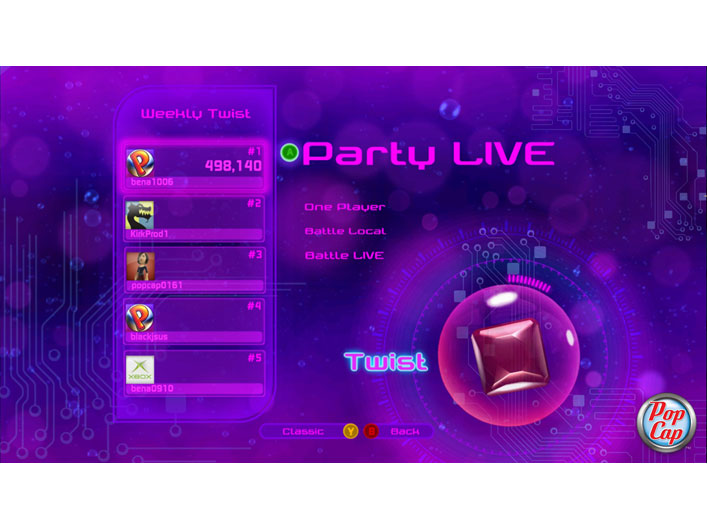
So what's different with this game than its Facebook application equivalent? Well, with it not being a Facebook app and a full game instead, they couldn't just port it straight. It wouldn't be worth any price, what with the Facebook application being free providing naturally, you have Facebook. So they had to spruce it up a little. And that's exactly what they did. There are two modes available in Bejeweled Blitz Live on the XBox Live Arcade. You have the traditional game that's available on Facebook. Sixty seconds, get as big a score as you can. The second mode is Bejeweled Twist mode. Bejeweled Twist is another relatively successful variation of the quite overworked Bejeweled formula; it requires you to twist the gems in a clockwise or anticlockwise motion, rather than side to side like in the original mode. It's a tactically harder game but if mastered, it's arguably capable of getting a better score. You can play against your friend, or up to fifteen friends if you connect via XBox Live. Haven't got any friends that play the game? Well you can play against up to fifteen random strangers as well.
Twist or Classic. Any other options? Nope.
What else is there to offer on this game? Well I hate to break it for you, but that's all there is. Nothing else. You have these two game modes and that's pretty much it. So if you have a Facebook account and like Bejeweled Blitz as an application, you're not really missing out on anything here, unless you desperately want to try out Bejeweled Twist that badly. Oh, and that's available as a Facebook application too, to my knowledge as well. So yeah, you're not really missing out on anything at all, unless you want to play the game against multiple people at the same time. But that, for me, is not the only thing that's bad about this game.

For me, what I find equally as annoying about the XBox Live version is the sound and music. It's quite frankly, atrocious. To cut some slack a little, I can appreciate that a game like Bejeweled Blitz isn't about the music and more about the action on the screen, but having some drum and bass music in the backgrounds really takes the biscuit a little. Why? Well it's simply distracting. I have Bejeweled 2 on my XBox Live as well, and comparing the two games for music, Bekeweled 2 has ambient music. You know, calm music. Music that doesn't detract from the action. Having drum and bass was a terrible mistake. Not only that, but you have a female narrator telling you that your time is running low as you approach the end of your sixty seconds. I think that's also a bad move, as it makes you panic a little as you try to boost your score as high as possible before the clock runs out. On the Facebook application a horn makes a noise as your approaching 'time up' and while that's a little frustrating, it's nothing on this. It makes me want to play Bejeweled Blitz Live on mute if anything.

Two more things that need to be brought up that are, sorry to report, negative, are the colours. In other Bejeweled games you usually have pretty colours in the background but colours that contrast the gems and the foreground. In this game, they've opted for a more dark colours scheme; dark blues, reds and yellows and darker greys. While you can tell your gems apart and everything, it's still an inferior choice of background schemes than in previous games in the series. The idea is to have nice backgrounds that don't interrupt play, and while these backgrounds aren't in your face, they're still a little distracting. It just feels at time with the music and colour schemes that having a rave is more important than playing a game of Bejeweled. Another thing that is worthy to mention is the controls. If you like playing Bejeweled Blitz on Facebook with your mouse then you'll probably find the controls difficult with an XBox control pad. It's harder to twist gems around with the control pad than with a mouse. That's not criticising PopCap, in the end, the game is just more well suited to a PC than an XBox.
WOW! Loads of things going on at once! I can't see properly...
To summarise, Bejeweled Blitz Live is only worth getting if you really like the Facebook application but simply don't have a Facebook account anymore. Or, if you like the idea of playing Bejeweled Blitz with loads of people at the same time competitively. Otherwise frankly, this game is a ripoff. Considering you get the best of the game for free on Facebook completely makes the purchase unjustified. It just feels like PopCap wanted to milk as much money from this overworked formula as possible, and saw a market on XBox Live to make some money. Well, it worked. I'm not saying Bejeweled Blitz Live is a bad game, it's not. It's Bejeweled. If you've played it before and like it you'll like this. But... why don't you just play it for free on Facebook? It's just not worth buying it for XBox Live... apart from the reasons above. Have many friends that like Bejeweled Blitz and are also worth willing to spend the money buying this game individually? Then it might be worth it. Or, play against up to 15 strangers if you like that. That aside, seriously, save your pennies and avoid buying this game. If you want a Bejeweled game on the XBox then I'd recommend you get Bejeweled 2 or 3, depending on how updated you want the game; there's not much between those two games either. As I said, it's an overworked formula, a good one, but man, it's overworked.

Rating: *** stars
For the latest updates on my work, 'like' me on Facebook here!

Tuesday, February 28, 2012

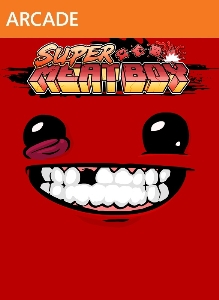
Game Review: Super Meat Boy

If you don’t lose your head over the difficulty, Super Meat Boy is an awesome homage to retro 2D platformers.
Super Meat Boy was released sixteen months ago on the Xbox 360 Live Arcade and was produced by Team Meat. It’s also seen releases on the PC, the Mac and on Linux since. It’s a 2D platform game and pays homage to the old school genre in general, particularly Super Mario.

Super Meat Boy is the sequel to an online Flash game called Meat Boy. Meat Boy was released on cult gaming and humour website Newgrounds three and a half years ago. Newgrounds is a website where many animated videos and flash games are posted. Meat Boy was a huge success on there and had over 8 million hits on all internet media. It was then decided that the success of Meat Boy could possibly be found on console gaming, so for the next two years hard negotiating, contracts and production were made to release Super Meat Boy. Team Meat contact all three major console gaming companies. Sony were not interested, and Microsoft showed a little interest. The most interest came from Nintendo. Microsoft made a large surge in the end for interest in the game, and a nice contract was made for the release on the Xbox 360 Arcade. Due to contractual obligations, it was to be released on the Xbox 360 first and lots of blood, sweat and tears went into the game, as well as a lack of sleeping hours to get it released on time. So much effort went into the game in the end that the game ended up being too big for Nintendo’s WiiWare, so they had to pull out, as Nintendo were not interested in a physical release for the game. So it ended up out of the three consoles, to be Xbox exclusive, and has since met major critical and commercial acclaim. I’m sure Sony regret their lack of interest now.
This is not going to end well...
Super Meat Boy follows a very simple story line. You play as Meat Boy, a red square with pixels for eyes and a very animate mouth, and small limbs. His girlfriend, Bandage Girl has been kidnapped by the main antagonist, Dr. Fetus. It’s such a simple storyline and the creators are emphatic on this, due to it being a strong homage of the simple storylines in the late eighties video gaming, particularly Super Mario. There’s no extended plot really, you as Meat Boy follow Dr. Fetus through over 300 levels to try and save the girlfriend, Bandage Girl. No further plot is needed either.

The game itself as mentioned earlier is a 2D platform game. To finish one of the 300+ levels, you start off at the far left of the level and have to make it to the end of the level, where Bandage Girl is waiting. You control Meat Boy and run and jump your way through obstacles to reach her, only for Dr. Fetus to take Bandage Girl to the next level. The game is split into 20 levels for the most part, “chapters” as they call them, where at the end you’ll have a Boss level where you have to once again either find Bandage Girl at the end of the level, or more often than not, run away from the boss themselves. Minor story continuation is usually shown between each “chapter” you visit.

Meat Boy himself is a square piece of meat. It sounds quite disgusting, and it is in theory, but the fact that the game is in 2D means nothing is really shown, the game is for the most part probably a 12+; the game itself shows very little that’s graphic or unsuitable for children but there are small references here and there that aren’t suitable. For instance Dr. Fetus quite often likes to stick his middle fingers up at the screen or Meat Boy, but those subtle things aside it would probably class as suitable for children in honesty. Due to the fact that Meat Boy is a piece of meat, whenever he runs, small trails of blood follow him everywhere he goes, once again it sounds quite horrible but it’s all pixelated and is fine once you get over the initial observation. Whenever he runs or moves, small squishy sounds follow him, to emphasise the piece of meat that he is as well. This paragraph is here to tell you that yes, these things are present and if it offends you not to show your children if you have any, that’s understandable, but for the most part it’s absolutely fine for children, if they don’t understand these things.

To control Meat Boy, you use the D-pad like always, and that lets you move Meat Boy left or right on the screen. To jump, you press the “A” button, and you can also jump off walls, multiple times, so you can jump from wall to wall to wall if you’re in a short space. You can also run by holding the “X” button while you move. To jump across large spaces you have to hold the “A” button while jumping. It’s very simple really.
The intro to Super Meat Boy is homage to Street Fighter. If you play the game you'll know what I mean.
But what makes the controls so amazing is how tight everything comes together. Have you ever played “Super Mario” back in the day, and the controls were hard to get your head around when first playing? There’s none of that while playing Super Meat Boy. The controls are incredibly tight; when you stop moving, Meat Boy stops moving. If you time everything correctly, you’ll jump, skid, run and drag against the wall (hold the D-pad direction against the wall to drag) as you are supposed to. The controls in essence, are what bring everything in Super Meat Boy together.

Because the controls are so tight, that usually means everything you do on Meat Boy is to your touch. There’s no blaming the game for bugs or the controls being poor. It’s your fault. And that’s quite frustrating in some ways. Why? Because this game is hard. It’s very hard. It’s really really hard! Team Meat worked very hard on making this game fun to play, but also challenging. There are over 300 levels in this game, but completing the first 40 is in some ways a challenge. But this game is a game of trial and error, you’re supposed to die, and die a lot, to be able to beat the level. Dying is only half the fun, because once you beat a level in Meat Boy, especially later on, it’s some achievement. You have unlimited lives, and the levels are short, and this equation makes for a fun yet frustrating game. You have to time things to an absolute tee (as I said, if you don’t, it’s your fault) to beat levels, especially later on

The levels for the most part take around half a minute to complete, but to beat each level it usually can take a lot longer. But don’t let this put you off, as I said, it’s difficult but the fact that you can try again and again instantly means you get a second go straight away. It’s the trial and error part of Super Meat Boy that makes it fun. If you were to flawlessly play Super Meat Boy it would be boring, trust me. Also, you don’t have to play the levels in order. They are however, as mentioned earlier, split into “chapters”, and to unlock the next “chapter” you’ll have to beat the boss in the previous one, and to unlock the boss of that chapter you have to beat a certain amount of levels. But if you get stuck and frustrated on a certain level, you can skip it, temporarily anyway, and come back to it another time.

There’s other ways to play Super Meat Boy. If you complete each level exceptionally quickly, you get an A+ stamping on the level. Doing this means you also unlock the “Dark World” version of the level. The “Dark World” version of the level is an even harder variation of the original level, meaning the difficulty of the level is increased even further! The “Dark World” levels are usually in design the same as the original level, but certain elements are usually added to increase the difficulty; either more obstacles are put in place to avoid, or certain platforms are shorter or not there at all, making the level harder to cross.
The boss battles are exceptionally challenging, but in a fun 'trial and error' way.
There are other characters to play as in Super Meat Boy, but all require unlocking. Most characters are unlocked by collecting plasters. Plasters are found on certain levels, usually in a difficult-to-reach section of the level, and the idea is to collect this plaster on the level and complete the level at the same time. Collecting a certain amount of plasters unlocks characters individually. All the characters bring something to the table; Gish plays almost identically to Meat Boy although he’s slower, but the main thing he can do well is stick to walls with exceptional grip, making him perfect for the levels in the game that are hard in this department. Jill has horns on her head and can stick to ceilings, while Tim can’t run at all but can turn back time three seconds, in case you do a mistake or fail to get a bandage or a key in the level.

Not all characters are unlocked by collecting plasters. Some are unlocked by finding warp zones on selected levels. Warp zones are great; they’re usually the same game but even more retro than the style the game is in. They’re usually thee levels of a much more pixelated version of the game, usually harder to complete and worse yet, you only get three lives rather than the unlimited lives you get in the main games. Beating certain warp zones unlock characters, and some even pit you as the character you’re about to unlock, rather than Meat Boy.

The game’s soundtrack is great. It’s not exceptional in terms of its quality, but it’s not supposed to be, the music is there simply to support the game, not to overshadow it. The music is often atmospheric to the level’s that are being played, and there’s also a lot of retro style music, especially for the warp zones. The sounds are also great, as mentioned, the squelches that are heard when Meat Boy runs or dies are perfect, and the guy who does the emphatic shouting of certain events (like “Super Meat Boy!” and “Warp Zone”, similar to the Street Fighter guy) are great too.

Overall Super Meat Boy is well worth every penny if you like retro games, it does the old 8-bit and 16-bit games of old complete justice. If you don’t lose your head over the difficulty, it’s well worth your time. I’d recommend you try the demo out, which is quite fleshy in itself and if you like that, get the full game. Just remember that the game is made for you to fail before you succeed, which is the way games were made in the eighties anyway. So if you don’t lose your head over the difficulty, Super Meat Boy is an awesome homage to retro 2D platformers and well worth a punt if you like Xbox Live Arcade games.
Rating: ****1/4 stars
For the latest updates on my work, 'like' me on Facebook here!

Sunday, February 12, 2012

Game Review: Plants vs Zombies


If I were to make a “50 Games to Play Before You Die” list, this would be towards the top.
Plants vs Zombies (will now be abbreviated to PvZ) was originally released on the PC nearly three years ago, but was then released on a multitude of platforms including the iOS, the Xbox 360 Arcade, the Nintendo DS, Playstation Network, the Nintendo DSi, the Android phone and the Windows 7 Phone. I have played both the PC and Xbox 360 versions, the latter being released nearly a year and a half ago. This review will predominantly covering the Xbox 360 version. Popcap are the publishers of PvZ, who also have made other excellent quirky and cartoony titles like Peggle, Bejeweled and Zuma. I’ve reviewed Peggle on this site, if you’re interested in reading that click here.

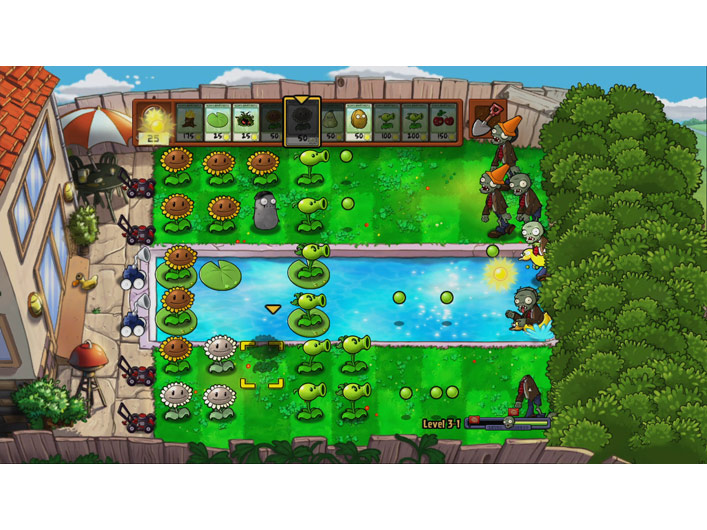
PvZ is a tower defence strategy game, a genre that despite not being that new is not very popular. The purpose of this game, like most tower defence games, is to stop an enemy attack invading your base. It sounds quite boring when you explain it like that but trust me; PvZ is not a boring game. It’s not a game for people who are purely into strategy games. It’s a game for everyone, even kids, as its difficulty levels start of easy and develop from there, and the visual style of the game is open to everyone. Most importantly, PvZ is a very, very funny game, and that’s one of its best features.
All the zombies want to do is party! Honest...
So what is different from this game than from the ‘boring’ and ‘mastermind’ strategy games? Well your ‘enemy attack’ is zombies, and your ‘base’ is, well, your house. This is a zombie invasion, and the zombies want to come into your house and eat your brains. And what are you using to cancel out the zombie threat? Plants. Yes, plants. It sounds barmy and it is. It’s bonkers. But it’s absolutely brilliant.

The bizarre concept of Plants taking on Zombies and the battlefield being your garden sounds like someone had too many mushrooms, but somewhere in that curiously thought out storyline is a small amount of logic. The plants all have different purposes. And for the most part, they are real life plants. Your main source of firepower is a peashooter. A peashooter, well, shoots out, erm, peas, as you’d expect. These peas hit the zombies and damage them, after ten shots from a standard pea a zombie will be defeated. This is the basis of the game. But there are 51 different types of plant (although they’re not all plants, some are vegetables and mushrooms) and 26 different type of zombie (in the main game, there are other variances too).

The main mode of gameplay is “Adventure” mode, and, you cannot play any other game mode until you have played through a certain amount of the main “Adventure” mode. So you start off with a peashooter but as I said, there are 51 different types of plant in your arsenal. To use any of your plants you need to something called sunlight. Sunlight is gained in quantities of 25 once in a while from the sun itself (if it’s daytime, there are night time levels). But your main source of sunlight comes from another plant, the sunflower. You get the sunflower on your second level. Sunflowers also give you quantities of 25 sunlight at a time, at a more rapid rate than the sun itself. This is where the game starts to really unfold. You’ll slowly start unlocking more and more plants that do diverse things to battle more zombies that have different qualities.
Eventually you'll get all sorts of different plants to kick zombie butt with.
What other plants are there? You start off with a peashooter, then the sunflower, then the cherry bomb. The cherry bomb is a bomb, naturally, and explodes zombies in a certain area of the garden). Then, you get a wall-nut. What’s a wall-nut? Well it’s a play on words, from the walnut plant. It serves as a wall to block the zombies from advancing on the garden grass. It’s this excellent wordplay that makes the game so much fun. There are many real life plants (and other things like mushrooms as I said earlier) that play on the words and make use in the game. Other great plants available in the game are the Jalapeno, which is a chilli, and he explodes across a horizontal area of the garden and the garlic, which makes a zombie go towards a different lane in the garden. But the best in my opinion is the butternut squash, which, hilariously, squashes a zombie. It’s just brilliant. The humour and play on words are what really sells the game.

The zombies as I said also vary and get tougher as you go through “Adventure” mode. You start of with the standard zombie, who walks across the terrain and eats any plants that are in its path. The zombies come from the right side of the screen so the idea is to place your plants on the far left so the zombies are hopefully disposed of before they get to your plants. Later on zombies start wearing protection, first road cones that protect their head for a longer amount of time, and then a steel bucket. Then we get hilarious gimmick zombies, like the American Footballer zombie, who wears full head and body gear and runs instead of the sluggish walking the standard zombies do. Later on you also get silly zombies like the “Newspaper” zombie, who is reading a paper and when your peashooters or other plants that attack shoot the paper from his hands, he runs at you in an angry fashion. There’s also a pole vaulting zombie who also runs at your zombies, but then jumps over the first plant it comes across. Certain zombies are difficult to dispose of, but usually have a weakness plant. The pole vaulting zombie for instance, is opposed to the wall-nut; the zombie pole vaults over the wall-nut but then runs at a very slow pace, giving you ample time to dispose of it. The American Footballer zombie is weak against the Snow Pea, which is a peashooter that also freezes the zombies. So the Snow Pea slows down the American Footballer dramatically, making him a lot easier to dispose of. There’s an incredible amount of zombies that get both sillier and harder to deal with, which adds to the complexity of the game.

In “Adventure” mode you have 50 levels, all in segments of 10. The first 10 levels are in your front garden and are relatively easy to play. The game’s difficulty starts off so easily so everyone can play it. The second set of levels are done at night time. The night time levels are more difficult because you don’t have access to sunlight as easily. The sunflower is a lot less effective at night and instead it’s recommended you use a new plant that’s quickly unlocked at that point called the Sun-shroom which is much more useful. The night levels have new zombies and plants, and also other subtle things like graves that you can dispose of with a new plant called the “Grave Buster”. The third set of levels are once again in the daytime but brings the action to your back yard, which has a pool. The difficulty is once again risen as Zombies start using your pool, either by wearing rubber duck tube or worse, snorkels. The fourth round of “Adventure” mode is also in your back garden but this time it’s back to night time, but it’s even more difficult as a dark and thick fog covers most of the screen. You start using other plants like the “Plantern”, a lantern that makes seeing in the fog much easier and also the “Blover”, a blowing clover that gets rid of the fog completely on a temporary basis. The last 10 levels take the action to the extreme – the zombies invade your roof! Because of the slanted roof tiles peashooters are of no use here, instead you start using catapult plants, first the cabbage-pult, then the kernel-put which lobs churned butter at the enemy, and then, the melon-pult which deals heavy damage (because melons are heavy obviously). At the end of the game, level 50 (or 5-10 as it’s displayed on game), you go against the final boss.

The “Adventure” mode is a great game. It’s the main mode and it’s so much fun. It takes a good few hours to complete “Adventure” mode so it keeps you entertained for a while. When you beat “Adventure” mode you can replay it and the difficulty remains similar, apart from three of the plants are chosen at random for you in the beginning (where as you can choose your own plants at anytime otherwise).

Slowly going through “Adventure” mode unlocks other mini games, puzzle games and a “Survival” mode option. Some mini games are unlocked before completing “Adventure” mode, but to get full access to them you must complete the main game and then play through the mini games one by one. Beating the mini games one by one slowly unlocks the games individually. The mini games vary, the first game is called “Zom-botany”, which is a science experiment gone wrong where zombies merge with plants and attack your house. It’s a tactically completely different game to the main game and you have to think outside of the box a little to beat it. Other fun games include “Portal Combat”, which pays homage to the Portal series, where Portals appear on screen and zombies can walk through them and end up on another part of the screen, increasing the difficulty, and the Portals move as the level goes on to further add to the problems, another fun game is “Column Like You See 'Em”, which is an absolutely manic level where one plants equals a plant on every section vertically, and zombies come at you in equal measure; one zombie of that type in every vertical column. It’s complete madness but a lot of fun at the same time. There’s a total of twenty mini games and they’re all fun in different ways, and definitely fill the game up, giving you plenty to do if you finish the main game.
Crazy Dave is definitely one of the best things about PvZ, he's incredibly funny and CRAAAZYY!!
There are also twenty Puzzle games in the “Puzzle mode, but it’s only one of two types. First is “Vasebreaker”, which gives you a hammer to break vases containing either random plants or random zombies, and the task is you break all your vases, defeating all the zombies and protecting your house all at the same time. It’s tactically a tricky game to play as you don’t know if you’re breaking a vase that will help you or hinder you. There are ten different “Vasebreaker” levels and they vary in difficulty, ending in the last of the ten beign “Vasebreaker Endless”, which continues playing “Vasebreaker” for as long as you can, and you have to try and extend your undefeated streak for as long as possible. The other ten Puzzle games are “I, Zombie”. This Puzzle game puts you in the shoes of the zombies rather than the plants and your aim is to actually eat the brains of the person living in the house. Your zombies have different values not too dissimilar to the plants, and you use sunflower this time to activate zombies to eat the plants rather than the other way round. It’s once again tactically different to the main game as you have to think of ways to eat the plants and eventually, eat the brains you were trying to defend in the actual game. The 10 “I, Zombie” levels, similar to “Vasebreaker”, vary in difficulty and the last of the ten is “I, Zombie Endless”, which is exactly like “Vasebreaker Endless” but you’re trying to extend your streak in the “I, Zombie” games instead.

The “Survival” mode I mentioned earlier is a lot of fun. The idea is that you’re playing the main game and you have to survive a certain number of waves of zombies, depending on the difficulty. There are eleven different “Survival” games, the first five are the first five different battlefields and you have to survive five waves of zombie, the second five and the five different battlefields but much harder as you have to survive ten flags and the waves are much harder. The eleventh and final game is “Survival Endless”, which is like “Vasebreaker” and “I, Zombie” endless.

There are other little features, are more plants for you to unlock. After a few levels on “Adventure” mode, you’ll come across the only other known human in the game, the awesome Crazy Dave. Crazy Dave throughout “Adventure” mode gives you tips on the story and its progress. Later on he opens his own shop, and it’s here you get the opportunity to buy more plants if you wish. Crazy Dave is brilliant, he’s really funny and has some of the best lines in the game. After you finish “Adventure” mode you’ll have access to another feature, called the “Garden of Zen”. The purpose of this mode is simply to grow and sustain your plants, before selling them off for more coin to unlock even more features. You’ll also be able to grow something called the “Tree of Wisdom”, which gives you random bits of advice and passwords to unlock odd features like giving all zombies moustaches and the like.

Overall, “Plants vs Zombies” is a brilliant game. It’s hard to describe it without playing it. If I were to make a “50 games to play before you die list” this would be close to the top of it. It does much more than the generic tower defence game genre does, purely because it does it with so much charm and humour. I have yet to see one person dislike this game. It’s open to everyone from children to hardcore gamers to adults who don’t play many video games. It’s accessibility is universal and it’s just so much fun. If you’re still unsure whether or not to get this game give the free PC trial a go, you can find it by typing “free plants vs zombies” on Google. Popcap have it for free on their main site and you can get a real taster of what the game is about on there. Or on your Xbox 360 download a free trial on there. Popcap are really good for giving you free tasters on their games so give them a go. PvZ is one of the cutest, funniest and simplest games to come out in today’s hardcore gaming world. It makes a huge change and is more than worth your pennies.

Rating: ****1/2 stars


For the latest updates on my work, 'like' me on Facebook here!

Thursday, January 05, 2012

Game Review: Final Fantasy XIII


Overall, Final Fantasy 13 is a great game with a complex yet rewarding storyline and an awesome battle system.


Final Fantasy XIII was released nearly two years ago here in the UK, in March 2010, and was released on both the Xbox 360 and the Playstation 3. It is naturally, the thirteenth major chapter in the critically and commercially successful Final Fantasy series. The game’s official sequel, Final Fantasy XIII-2, is to be released next month.

Just in case you’re not too familiar with the series, Final Fantasy games have been released since 1987, twenty five years ago, and are a set of RPG games that have for long periods of time become the most influential and widely celebrated role playing games of all time. Many recurring themes in the series are the using of magic and summoning monsters, the use of airships, travelling across a world, characters dealing with love or loss, characters defying the powers of fate, religion or apocalyptic circumstances and the inclusion of chocobos and moogles, two creatures the game series has made popular. The highest point in the series was arguably the release of Final Fantasy VII in 1997, which was released on the Playstation, which was met to universal acclaim and has sold more than any other game in the series, at over 10 million copies and is only second to Gran Turismo on the console. Since then the sales and reception of the Final Fantasy series has changed; some games sold more than others and some games were better received. Final Fantasy XI marks the first online RPG in the series, and was followed up by last year’s release of Final Fantasy XIV.

Final Fantasy XIII follows Final Fantasy XII (that being said, none of the major games are connected officially and are set in their own styles and game universes), which was met with a decent response, with the main criticism coming from the fact that the world was expanded across an immense terrain with in some cases very little linear direction and large amounts of battles followed by short spurts of storyline progression. What did Square-Enix do with Final Fantasy XIII in response to these criticisms?
"He's behind you!" Ah... I love pantomimes.
FF13 (I’ll now abbreviate to numerals) in comparison to FF12 does exactly the opposite in terms of the world terrain and linearity. The game is linear, to the point that you cannot travel back to previous areas at all, nor is there varied places to explore in each area. The game, it feels, almost holds your hand throughout your journey, which is completely different to FF12, a world where you can go to so many areas so early in the game, even if the storylines don’t require you to go there. FF12 and FF13 are complete opposites in terms of how the rails of the story go; FF13 glues your hands to the rail where as FF12 shatters the rail completely.

Moving onto the story, before I explain what the plot is, I’d like to just say that the storyline is very confusing and hard to follow first time round. It doesn’t help when you’ve entered a game in a fantasy world that uses three different terms in fal’Cie, l’Cie and Cie’th all the time and you barely have time to digest the terms and learn their meanings. It confuses the plot from the off and it makes the story hard to follow at times, unless you click straight away, something I personally didn’t do on my first run. The second run through the game was a lot easier mind, and the story on this run was much better to follow.

The story follows the theme of fate, and how these six playable characters are chosen as servants of the fal’Cie, the game’s equivalent of gods, to complete a task (called a ‘focus’) to destroy the world, and how if they fail in their task, they’ll turn into grotesque monsters (‘called Cie’th’). If they succeed and complete their ‘focus’ their fate is potentially just as bad, as they will be granted crystal stasis, for as long as eternity. The name given to these servants is the ‘l’Cie’, and they are capable of using magic, and therefore the general citizens of the land of Cocoon are afraid of them. It’s a harsh fate that is given to these six individuals, and it takes them all on an emotional journey of deciding to give up on their task, to embrace their task, to run away from it and try to shake it off, or try even, defying it. It’s a great storyline once you understand it, one of the best storylines in recent Final Fantasy titles in my opinion, and one I’ve enjoyed more than any storyline since FF9.

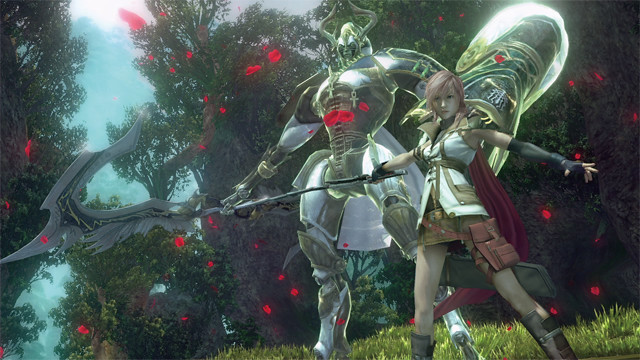
These six characters naturally all have different personalities and views on their situation. The main protagonist is Lightning, who’s sister Serah became a ‘l’Cie’ before the game begins, and at the start of the game turns into crystal stasis, having completing a focus that is unknown in task. Lightning, an ex-soldier, is seen as a very harsh character whose upbringing makes her take a bold and frank approach to these dire circumstances and often has the party she accompanies upset. Serah’s boyfriend, Snow, also is a main character, and only met Lightning days before the game starts and had a frosty reception from the ex-soldier, which leads to Snow often, get the brunt of Lightning’s frustrations. Snow himself, sees himself as a hero of Cocoon and uses his large stature and loud voice to carry him through his troubles of losing his girlfriend to crystal stasis and his refusal to accept his focus of destroying his home land. In an attack at the beginning of the game, Snow attempts to save a load of prisoned victims and the death of one particular person has significance to the plot. That is because it’s the mother of Hope that dies, who’s another main character. Hope has had a normal life on Cocoon and lives a life where Cocoon’s political pressures brainwash most of the citizens, especially when it comes to ‘l’Cie’ being hostile and basically, evil, so the despair that Hope goes through not only to accidentally become what he was thought to as evil, but to have to live with knowing who was arguably responsible for his mother’s death in Snow, leads to an interesting extension of the story.

The other three characters also have great story arcs; Sazh is a father whose son had also become a ‘l’Cie’ prior to the game’s beginning and has other issues too, but deals with them with a heavy heart but a happy smile. Sazh is an excellent character, definitely my favourite, and is probably the funniest character in the game. Fang is as forceful as Lightning is, yet shows a softer side to her much more often than the main protagonist does. She will do anything and everything she can to protect Vanille, who come from the same location in game and have a history together. Vanille is the hit-or-miss character of the game; she’s cute and bubbly and has all the traits of similar characters in Rikku of FF10 and Selphie of FF8, so you’ll probably either love her or she’ll probably either annoy you immensely. Vanille also operates as narrator of the game, and her significance to the plot is discrete but ultimately vital when the puzzle pieces all align. Without mentioning the main villain by name, the main antagonist in FF13 is absolutely fantastic, a much better villain than Vayne from FF12, and my favourite Final Fantasy villain since Kuja from FF9.

"RUN VANILLE! They're going to asplode!"
The game play has also dramatically changed this time round in comparison to FF12. We once again return to the ATB (Active Time battle) system used in most of the FF titles to date, but it’s a much-changed variation of it. The best way to describe this system is that it’s like the one used in FF10-2 but with much more action involved. So much action in fact, that you only control what is called a ‘party leader’, meaning this is the first Final Fantasy title where you can only control one character in battle, rather than the entire party. A usually very competent AI controls the party in support. Basically you can either use the battle system manually, where you can choose your actions, or you can use the very useful “Autobattle” command, which selects an option to you based on your enemy and any potential weaknesses, or in turn, any healing you may require if you are of the party support systems. But unlike a lot of the old traditional Final Fantasy titles, you have combos. You choose your commands either manually or automatically, and you can build your combo up to do multiple attacks in one go, in turn leading to a more smooth and sophisticated system which also looks good to watch and play. Your combos increase as the game goes on from two to six.

There’s more to add to this battle system. There’s something called a “Paradigm” system, where you can chop and change battle formations with different job titles. There are six different job titles, Commando, which uses mainly physical attacks; Ravager, which uses damage dealing magic, a Medic, which primarily uses healing magic, a Saboteur which weakens and debuffs enemies, a Synergist that buffs allies and the Sentinel who absorbs damage and protects allies. Towards the beginning of the game the characters start to acquire access from one to three of these titles and towards the end the characters can gain access to all six, although the three titles they acquire later can only be strengthened minimally. When the game is complete, you have full access to all six titles and can be strengthened fully. So the “Paradigm” system means you can mix these job titles to work in your favour, for instance if you have three characters you can have a Commando, a Medic and a Synergist; one character physically attacking, one character healing and one character strengthening the party. You can then change to a completely different system with the “Paradigm” system, to a defensive one, for instance having two Medics and a Sentinel gives you a lot of healing power and some defensive cover too. The “Paradigm” system really does battle tactics in a Final Fantasy game in a way that’s never been done before and I think it’s fantastic.

While you have these six job titles, naturally you have to strengthen them and strengthen your characters. This game doesn’t use the traditional levelling up system like most Final Fantasy games do, and instead lets you increase your character’s stats on something called the “Crystarium”. After battles characters earn Crystarium Points, or CP, and you use CP in the Crystarium to activate nodes that give you character abilities or stat enhancements, not too dissimilar to FF10. After certain segments throughout the game, you gain access to another level of the Crystarium, further advancing your characters abilities and stats. So you have the six job titles, if they’re unlocked at that point in the game, that you can increase your characters stats and abilities through, and in turn they make your characters stronger.

Final Fantasy XIII’s graphics are absolutely gorgeous. The motion videos are as great looking as any game on the new generation consoles and the landscapes of Gran Pulse, the other location other than Cocoon, in FF13, are utterly stunning. The characters look good, the enemies look even better and some of the bosses in this game, particularly the ones very significant to the plot later on, look tremendous, particularly the designs main antagonist. The sound in FF13 is as good as the series has always been and while the quality of the soundtracks of recent Final Fantasy games don’t match the amazing tracks of FF7 and FF9 in particular, FF13 does a decent job of getting the mood set for each location and event that occurs. I once again, prefer the soundtrack of FF13 than that of FF12, to compare.
FF13 on the whole is absolutely stunning, particularly Gran Pulse later on.
Now I’m sure you’ve noticed but I’ve compared FF12 and FF13 a lot in this review. There’s a simple reason why – they’re polar opposites of each other. Final Fantasy 12 concentrates a lot on the exploration of the world map, and lots and lots of battles. The story lacks in FF12 and its basic premises is stretched across the incredibly large open maps and battles. FF13 does the opposite. The game is so linear, and the cut scenes and story is to the brim in terms of depth and development. Once you get over the confusion of the storyline you’ll find a great tale to be told here, and while the ending is not as good as other titles in the series, you still get the satisfaction expected from completing a Final Fantasy game. But the linearity of FF13 is a problem. There are a lot of places in FF13 that you go to only once, and never to return. In fact, the game is split into thirteen chapters and you can only revisit the places in chapters 11 to 13. 3 out of 13 chapters are capable of revisiting. That’s pretty poor. And like FF12, there’s very few mini games, if any, in FF13 although there are one or two decent side quests. The game does open up replayability by giving you full access to each character’s Crystarium at the end of the game, for you to continue to develop your characters and take on the biggest and baddest battles in these side quests. And I said, you’ll probably enjoy playing this game a second or third time just because the chances are you’ll appreciate the great story more.

It is for these reasons why overall, FF13 for me is a great improvement on FF12, and my enjoyment of it is probably on par with FF10, although for different reasons. What keeps FF13 together is it’s great storyline and decent set of characters, combined with an ultimately unique battle system. Sure the game is really linear but in the end, you can get over that, especially as the areas that are revisitable are probably the most strikingly good-looking places in the game. Another flaw would be that I don’t like the fact that you only control one character in battle, I like taking a party of characters into a battle and using all of them to beat my enemies. But overall Final Fantasy 13 is a great game, with a complex yet rewarding storyline and a great battle system. If you want my recommendation whether or not to buy or rent it, well, look at the general consensus of what I and most other people have said, and make your decision from there. If you can get over the game’s flaws, you’ll find a brilliant game in FF13, its’ one of the best RPGs in recent years.

Rating: ****1/2 stars


For the latest updates on my work, 'like' me on Facebook here!
Wednesday, December 14, 2011

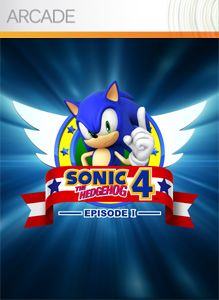
Game Review: Sonic the Hedgehog 4: Episode I


Sonic 4: Episode I is a great, yet not spectacular sequel, 16 years overdue that should appeal enough to new and old fans alike.


Sonic 4: Episode I was released back in October 2010 on multiple platforms including the Xbox 360 Live Arcade, Nintendo Wii, and the Playstation 3. It’s considered the direct sequel so “Sonic 3 and Knuckles” the two games released in 1994 on the Sega Mega Drive and Genesis, marking a sixteen year gap between the two sets of games.

Now unless you’ve been living under a rock chances are high that you know that many MANY Sonic games have been released in the sixteen years between these games. But a lot of fans of the Sonic games lost interest and disliked the direction that Sonic took after the release of the classic Sonic titles. Sonic 3D back in 1996 was received poorly, and while Sonic Adventure, which was released on the Sega Dreamcast in 1998, was received quite well, a lot of the older fans didn’t like the change in style that Sega were adamant on keeping. The newer Sonic titles were in full 3D and still concentrate on his speed but in the 3D environment the controls are very poor when in relation to the speed they were setting. Sonic Adventure 2 was then released three years later in 2001 and was also relatively well received by newer fans, but disliked by fans of old. The gameplay was changing even more with the release of Sonic Heroes in 2003 on the Nintendo Dreamcast, Xbox and Playstation 2, with the multiplayer aspects and the idea that you control more than one character at a time, but once again the game was well received by newer fans, and disliked by the classic fans.

There has been a big debate about the Sonic series since 1994 as you can tell. The reception of most games were mixed to positive by newer fans but mixed to negative by older fans. Sega wanted to keep up with the times and move forward with a 3D hungry video gaming world. They had mixed results doing this. But the all time low for Sonic was the release of “Sonic the Hedgehog” in 2006, released on the Xbox 360 and Playstation 3. This move was bold as Sega were attempting to use the “Sonic the Hedgehog” title again rather than move to spinoff titles. It was seen as a series redesign and an attempt to appeal to both new and old fans alike. The game was received extremely negatively, by both new and old fans for its poor controls and its attempt to make the plot deeper with an awful storyline. It’s to some considered one of the worst games ever made. After this release a lot of fans really started to turn on the Sonic series, as it had been such a long time since a truly great Sonic game was released. Despite the Sonic Adventure series receiving decent reviews, there was no true gem in the Sonic series since the Sega Mega Drive/Genesis days. They then released Sonic Unleashed in 2008 on the Playstation 2 and 3, the Wii and the Xbox 360. It merged some new gameplay with some old school game 2D gameplay from the 16-bit era and the game was warmly received by both sets of fans.

Then, one year later, it was revealed that Sega were to finally make a game directly targeted to appeal to old school games. The game would be fully 2D and would bring the gameplay back to its older days. The music would be reminiscent of the music in the older games and some of the enemies from these games would make returns. It was also decided that the only character available in the game would be Sonic the Hedgehog himself. The game, once again quite boldly, was to be called Sonic the Hedgehog 4. A lot of fans immediately thought back to “Sonic the Hedgehog” back in 2006, a move that was a failure to bring back some of the old fans. Was labelling this new game “Sonic 4” to be a success, or a failure?

Sonic the Hedgehog 4: Episode I brings the plot back to 1994 and take place straight after the events of “Sonic 3 and Knuckles”; Dr Robotnik (NOT Dr Eggman, I refuse to use that name in this review again) has been defeated and his space station is destroyed. Sonic takes a break away from his friend Tails and his new companion Knuckles and goes to explore new places on his own. Little does he know that Dr Robotnik has returned and he has reconstructed some of his own old creations to make them bigger and badder than before, and to stop Sonic once and for all.
He must have stolen something really valuable if he's running THAT quickly.
The gameplay for Sonic 4 does indeed return to its roots; it’s the simple 2D terrain and Sonic runs forward with the press of the D-pad or analog stick. He can jump on enemies and boxes, and the Spin Dash, first featured in “Sonic the Hedgehog 2” returns. The Spin Dash is done by pressing the D-pad downwards and pressing the jump button multiple times, and allows Sonic to roll on the ground at a high speed. The game has returned to its roots, but the major addition to gameplay in “Sonic 4” is the addition of the Homing Attack; when Sonic is mid-air a target may appear on an enemy, a bumper or a box, and by pressing the jump button again, Sonic immediately homes into his target at high speed. This however is a welcome addition to the old school gameplay as it gives the title its own flavour and separates the game slightly from its predecessors. Older fans think this too; not all change is bad after all.

The levels look fantastic in Sonic 4. There are five levels, four of them have two acts and a boss battle and the fifth level is a large final boss battle with multiple stages. The graphics for Sonic 4 are smooth and colourful and look even better in HD. Despite times changing in the past 16 years and there being more and more emphasis on 3D games now, these 2D graphics are just excellent. Sonic games have always been vivid and lively in its colour palettes and this is no different, it’s just done stronger now than ever before. The five levels are all homage and tweaks to levels in the original Sonic titles; first you have “Splash Hill Zone”, which is homage to “Green Hill Zone” from the original “Sonic the Hedgehog” game, then you have “Casino Street Zone” which pays tribute to “Casino Night Zone” from “Sonic the Hedgehog 2”, “Lost Labyrinth Zone” has many elements from the original “Labyrinth Zone” from “Sonic 1”, and “Mad Gear Zone” has a very similar design to “Metropolis Zone” from “Sonic 2”. The final boss level, which is only unlocked if you beat all four zones and their respective boss levels, is the “E.G.G. Station Zone“, which combines many elements from the previous four boss levels while adding a new final boss, one that is very similar to the final boss from “Death Egg Zone” from “Sonic 2”. All of these tributes are more than welcome additions to the game, the only problem otherwise being that some of the levels and designs can be argued to take too much from the original game series, but it is of my personal opinion that there’s enough originality and tweaking here to see it as homage rather than recycling old materials.

I said earlier that you have to beat all four zones and their boss battles to unlock the fifth and final zone. However one major change to Sonic 4 that was not done in the original series is the flexibility of completing your acts and boss battles in any order you wish. When you load up Sonic 4, you must complete Act 1 of “Splash Hill Zone”, after that however you have access to a screen that you can select any of the four zones in any order. If you beat Act 1 of that level, then the second act opens up, then the third if you compete the second, and then the boss battle when you finish the third. But by all means go straight to “Mad Gear Zone” once you have access to this screen if you wish. My feelings on this are mixed, as I loved the idea of you going through the levels in order of events as it made you feel like you were following Sonic on his amazing adventure like a story. However with the times completely changed from the way things were 16 years ago you can understand why Sega have decided to give you access to nearly everything from the get go; we live in a generation where we are impatient and want to do things straight away, rather than unlock our rewards with hard work. Another addition naturally are the leaderboards, where you can compare your time and point tallies to other people who have played the game across the world.

There are other elements from the original series that remain in Sonic 4. You still have to jump on enemies or spin into them to defeat them. You still have to pick up rings, and if you get hit by an enemy you lose all of those rings. If you have no rings and get hit you lose a life. The boxes you can jump on still contain 10 rings, an extra life, running shoes to make you run even faster, temporary invincibility and a shield. Unlike “Sonic 3 and Knuckles” however there is only one shield, similar to “Sonic 1” and “Sonic 2”. A shield lets you take one more hit from an enemy, giving you extra protection and saves you from losing your rings. One thing that is different however is that there are no continues in Sonic 4. Once again the idea of having continues is silly in a modern gaming environment so it simply doesn’t need to exist.
He must have stolen something really valuable if they are releasing giant BALLS at him!
When you finish an act, like “Sonic 1”, if you have more than 50 rings you will see a large ring that Sonic can jump into, leading to a Special Stage. These Special Stages are too, reminiscent of the ones that were added in “Sonic 1”, where you have to guide Sonic through a puzzled level full of bright lights and rings, to the end where a Chaos Emerald will lie. The big difference between these Special Stages and the ones in “Sonic 1” is that you control the level in this game, and you must move the level rather than Sonic to get him to go in the right directions to the end, where as in “Sonic 1” you controlled Sonic and made him move and jump through the stage. If you collect all 7 Chaos Emeralds, you will have access to Super Sonic, golden, faster and invincible version of himself, like in Sonic 2, 3 and Knuckles. To activate him, you must first accumulate 50 rings, and as he is set off, your rings deplete by one per second, and if you run out, you’ll revert back to normal Sonic. Super Sonic is another great welcome in the series, and the times and points tallies on the leaderboards separate between just Sonic, and levels where Sonic and Super Sonic where used, so it’s good fun.

The music in this game is indeed reminiscent of the music found in the games released on the Mega Drive. It’s still crisp and clear enough to tell that it’s got a tinge of modernisation, but the move is certainly welcome, and the music immediately brings you back to the days when the music was so good. A lot of the newer Sonic games try to incorporate rock and metal music rather than the soft dance/techno sounds found in the games released in the early nineties. The sounds are also pretty much exactly the same as the classic games, with Sonic’s jump noise, the collection of rings, opening of boxes and spin dash all sounding as great as it did back in the day.

The main problem with Sonic 4: Episode I for me is the controls when it comes to high speed movement, something that has always been a problem with modern Sonic games. Sonic moves very fast as he always does, and in the older games released 16 years ago and prior, the gravity defying movement was controlled perfectly, with very few hitches. While this game for large parts deals with the pace and the movement of Sonic well, there are times when Sonic stops, or hits the end of a wall. These situations are quite irritating as some of the finest memories of Sonic are when he’s in motion, running or rolling across a terrain with ease and grace, and for a glitch or a wall to be hit in a way that the game doesn’t like unexpectedly, brings the motion to an abrupt halt. Another thing is that Sega have also made Sonic fall with good poise on some occasions rather than him fall in a ball movement like he used to. Sonic will look downwards at the ground below and in this stance he is vulnerable to attacks, where as when he is rolling downwards from the sky he is in an attacking stance, and will land on his enemy crushing it. This can catch you out at times when you want to attack certain enemies below you as you’ll lose your rings if he is not in his rolling attacking stance, and there seems to be no consistency with it.

Another problem that was once raised was the length of the game. The game has three acts and a boss level for four zones before the final boss. Tally that up and you have 17 levels in total. Considering when the game came out it was 1200 Gamerpoints on the 360, around £7 on the Playstation 3 and 1500 Wii Points, which are considered steep prices for the “arcade/downloadable” stream of gaming available, it’s still pretty cheap. These games cost anything from £30 to £50 when they were individually released back in the early nineties, so complaining about the price is silly. Remember that “Sonic 1” had six zones of three acts, totalling 18, and “Sonic 3” had even less; six zones of two acts, totalling 12, so this isn’t a bad deal. Not only that, but the games have since been reduced in price on both the 360 and PS3.
The special stages are as difficult and trippy as they ever were.
The most important question in this review simply is, does the game live up to the expectations and hype? Will the old school fans be happy? Overall, I think the answer is yes. Sonic 4 does a great job in bringing nostalgia and homage to the old series while doing just enough to clarify its position as an individual title released sixteen years later. Sonic 4 is a fine, if not extravagant effort that should bring old and new fans together to appreciate what was so amazing about the series in the early nineties. The music, the level design, the enemy design and most importantly, the 2D design are all reminiscent of the classic games yet the Homing Attack, the new level select menu, and the leaderboards all serve reminders that this is the 21st century; a game released in 2010 not 1994. And the game does a good job of balancing elements from both worlds, and, both sets of fans, old and new. Overall, Sonic 4: Episode I is a great, yet not spectacular sequel, 16 years overdue that should appeal enough to new and old fans alike. There is room for improvement, and I hope that Sonic 4: Episode II will deliver that promise.

Rating: **** stars


For the latest updates on my work, 'like' me on Facebook here!


Saturday, November 19, 2011

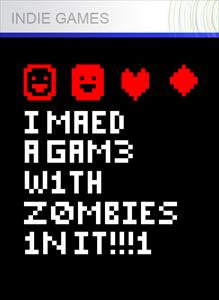
Game Review: I MAED A GAM3 W1TH Z0MBIES 1N IT!!!1

At 80 Microsoft Points, seriously, get this game or get a free trial, it’s just something you have to experience if you have Xbox Live Gold.

I MAED A GAM3 W1TH Z0MBIES 1N IT!!!1 (I’ll now refer to it as Zombies!) was released just over two years ago and is an Indie title available on the Xbox Live Arcade. It costs 80 Microsoft Points (which is around 68p) and can be downloaded if you have Xbox Live Gold. Why am I reviewing this game? My wife thinks I’m silly for reviewing it. I’m simply reviewing it because it’s just such an amazing game, no matter how short or silly it is.
This game doesn't look like much, but trust me, it's not supposed to.
Zombies! is an action shooter of the simplest controls. Your two analog sticks are the only things you use, one is used to manoeuvre your player, the other is to shoot in your preferred direction. The game can be played by up to four people at once, and is viewed from an aerial perspective. You simply shoot your enemies that are coming by the hordes, towards you. You get points for each enemy you take down and your enemies kill you simply by touching you, causing you to explode. As I said, the game is very simple, but it’s what else Zombies! brings to the table that makes it stand out.

You see, there is just one level. That level is probably around 20 minutes long. As you progress through the level, more and more enemies come at you, which results naturally in the game becoming more difficult. As I said the game is for up to four players, and the more players you have simply means more enemies are on screen. I say enemies rather than zombies because as the level progresses you encounter more than just zombies. There are about six different enemies to encounter, first is the zombie, then you have these worm-like things that glow, and later blobs of green goo that explode into smaller blobs, little diamond shards and some random angry faces. There are also zombies that are a slightly different shade of green that explode on contact, so these are slightly harder. The game is just bizarre.
It's not just zombies that you have to take on. Look at those weird mouth things.
In terms of how to deal with the undead and peculiar, you shoot them with your gun. Now you can get weapon upgrades as the level goes on, there are many different varieties of weapon that do different things, one is simply a machine gun that fires more bullets and quicker, there’s a laser that slices through multiple enemies, there’s a flamethrower, there’s a weapon that shoots in three different angles, there’s more. As well as weapon upgrades there’s also a shield, this is used to protect you from getting hit by putting it as a radius around you, there’s something that makes you move faster, and there’s extra lives. You start the level with five lives and that’s five hits, if you lose if you score high enough you’ll get put through to the (offline) leaderboard. Extra lives are very important if you ever want to finish this game. And that’s the thing, finishing this game is actually quite hard. The game starts off nicely, but the difficult cranks up quite quickly, you have to dodge enemies and kill hem as quickly as possible.

What stands out most about this game is the song. As I said, the game is one level that is around 20 minutes long, but there’s transitions in the level that also change the song’s pace and sound, as well as the backgrounds that the level is played on. The song is just absolutely brilliant. Lyrically, there’s only singing in the beginning and the end of the level but what consists in the game for words is hilarious. The lyrics basically describe the song, the game, and the fact that it costs you $1 (in America) to pay. Without ruining it I don’t really want to put any lyrics down on here, but it’s just excellent and funny. The rest of the song is mostly metal and techno music, but it sounds very good, it’s not bad quality music at all.
And the hordes get even bigger than this. You get immense satisfaction for finishing this game.
Zombies! is just something you just have to experience if you have Xbox Live Gold. Seriously, get a free trial of the game, or just buy it, as I said, it’s 80 Microsoft Points and that’s only 68 pence. You’ll get so much out of this game for its price, a better experience than games that are coming out now for £20, £30, £40 or £50. The game is so good the person that made it (yes, just one person made it) has made probably close to $250,000 off the game. It costs $1 to buy it, and he gets 70 cents for each purchase. The game has sold over 320,000 copies so far, because it’s so good. It’s a bargain. The game is silly, stupid, pointless but ultimately simple, hilarious, and a snip at 80 Microsoft Points. Get. This. Game!

Rating: **** stars

For the latest updates on my work, 'like' me on Facebook here!