Showing posts with label kiss. Show all posts

Wednesday, March 18, 2015

My Top 100 Favourite Music Videos: #87

#87: "Rockstar" - Nickelback
Release Date: 2006
Director: Dori Oskowitz
Fun Fact: So many celebrities feature in this video, to name a few, Billy Gibbons of ZZ Top (who also has spoken parts in the verses), Dominique Swain, Gene Simmons of KISS, Eliza Dushku, Wayne Gretzky, Kid Rock and Ted Nugent!
I'm expecting a mixed to negative reaction to this inclusion simply for praising Nickelback in any format, and for the fact that some people absolutely hate this song.

But I'm sorry to say, I've always liked both the song and the video. I do very much dislike this band and like maybe two of their songs? But this video is great. If you don't agree, fine. But I'd put money on the fact that I bet the first time you saw this video, you didn't turn it over. I bet you watched it the entire video. Why? Because you wanted to see who was in the video. How many celebrities are in the video? There's loads, the list above is just a sample. So like it or not, this video gets your attention, and I thoroughly enjoy/enjoyed watching it... until it got overplayed massively!

Here's the video for your enjoyment!


Click here to see #86 on the list or here for #88!

Sunday, December 22, 2013

The Rock and Metal Double Feature Show Christmas 2013 Special 20/12/13


Why hello there. Back again with another show I am. Don't know why I'm writing like Yoda. Anyways, this show is a Christmas Special. It's a mixture of Rock and Christmas themed songs, then Metal and Christmas themed songs.

Any feedback is appreciated if you listen to the show, the link is below!


The Rock and Metal Double Feature Show Christmas 2013 Special: 20/12/13

Track listing:
The Rock Show
Proper Crimbo - Bo Selecta
No Particular Place to Go - Chuck Berry
Here Comes Santa Claus - Gene Autry
Bad to the Bone - George Thorogood
Stop the Cavalry - Jona Lewie
Train in Vain - The Clash
Power of Love - Frankie Goes to Hollywood
Supersonic - Oasis
2000 Miles - The Pretenders
Breed - Nirvana
Christmas Day - She and Him
Lucky You - The Lightning Seeds
I Don't Care - Fall Out Boy
Fairytale in New York - The Pogues and Kirsty MacColl

The Metal Hour
Paradise City - Guns 'n' Roses
Christmas Time (Don't Let The Bells End) = The Darkness
I Was Made for Lovin' You - KISS
Highway to Hell - AC/DC
Whiskey in the Jar - Metallica
Break Stuff - Limp Bizkit
Everywhere I Go - Hollywood Undead
Santa Claws is Coming to Town - Alice Cooper
The Biggest and the Best - Clawfinger
Kidnap the Sandy Claws - KoRn
Sucked In - Jerk
Redneck - Lamb of God
Walking Corpse - Brutal Truth
X-M@$ - Corey Taylor

Merry Christmas everyone!

Other entries you might want to read:
The Rock and Metal Double Feature Show (14/12/13) - DJ Show
Download Festival Special Show - DJ Show
The Rock and Metal Double Feature Show (30/11/13) - DJ Show


For the latest updates on my work, follow me on Facebook and Twitter here!

Tuesday, December 20, 2011

Music Album Review: Welcome 2 My Nightmare by Alice Cooper


“Welcome 2 My Nightmare” surpasses the original album released 26 years prior, and shows that music doesn’t have to be serious; it can be pure entertainment and fun.
Alice Cooper released “Welcome 2 My Nightmare” three months ago. It’s his 26th album and is the official sequel to “Welcome to My Nightmare” which was released ironically, 26 years ago. Three years ago Alice Cooper released “Along Came a Spider” and was considering doing a sequel to that album, but when producer Bob Ezrin (who also sequenced The Fragile by Nine Inch Nails and has worked with well respected artists like Pink Floyd, KISS and Peter Gabriel) didn’t like the idea of a sequel to that album proposed they do a sequel to “Welcome to My Nightmare” instead, Alice Cooper liked that idea more. Alice Cooper was touring extensively while the album was being prepared for release and expected it to be released next year, but released it in September instead.

The album starts off with “I Am Made of You” which is a great intro, showing the homage to the past while using modern influences too. How? Well the tune in the beginning is from the track “Steven”, arguably the best song on the original “Welcome to My Nightmare”, but you can clearly hear Alice Cooper using modern auto-tune in this track, which divides me personally as I hate auto-tune, but it doesn’t take too much away from the track. It’s a great opener, and it does its job well, which is set you up for the rest of the album.

After the intro track, we’re treated to “Caffeine”, which shows pretty much all sides of Alice Cooper in one track. On one side you have a decent hard rock/metal track, but you also see the silly side to the shock rock legend, which is that he’s simply, singing a song about needing caffeine. Yes, that’s what this song is about. And the chorus is “Caffeine! Caffeine!” in a squeaky voice. It’s incredibly cheesy but there’s absolutely nothing wrong with that at all. If you haven’t followed Cooper’s career much you need to realise that this guy has never taken himself seriously. Ever. He’s an entertainer and plays the part so well.

“The Nightmare Returns”, track three, basically sets up track four, “A Runaway Train”, and is Alice Cooper describing his incapability of sleeping. “A Runaway Train” which shows tribute to country music and has a drum beat similar to a train on tracks. It’s a decent track, it shows another side to Cooper that he doesn’t show too often but in all honesty Alice Cooper plays what genres he feels he can pull off, and trust me, he can pull of loads, and he proves he can do country well here.

But track five, “Last Man On Earth”, is my favourite song. It’s so fricking cool, it shows so much swagger and glamour, and Alice Cooper’s vocals are brilliant. The song follows Alice Cooper off the “Runaway Train” from the earlier song, where the train crashed. If you think Alice Cooper is a has-been, he’s lost it, he’s a relic and can’t go anymore, seriously, give this a listen and it will prove you wrong. This song is easily as cool and smooth as his seventies stuff. In fact, this song is proof that Alice Cooper’s “Welcome 2 My Nightmare” project is a success.

“The Congregation” is apparently inspired by The Beatles according to Cooper himself but it reminds me more of the general glam-rock sound of the seventies, a sound and era that Cooper was attached to quite closely. If you listen properly you’ll hear a cameo by Rob Zombie, whose very good friends with Cooper. It’s a good song, very catchy and it continues to use modern and old influences in this hybrid album. “I’ll Bite Your Face Off” is track seven and is so far the only single off the album. It’s an odd choice if you ask me, but then again Alice Cooper doesn’t always choose his singles well in my opinion. But it’s a decent traditional seventies rock song, a nod to The Rolling Stones according to Cooper himself, it’s as decent as most of his singles over the years have been. I don’t know if Alice Cooper will release any more singles off this album, purely because he doesn’t chart anymore, he makes music for fun and for his fans rather than to make money. That being said, “Welcome 2 My Nightmare” is Alice Cooper’s highest charting album since 1994, when he released “The Last Temptation”, and in the US since 1989 when he released “Trash”, so that’s great news.

One of the best songs on the album for me is “Disco Bloodbath Boogie Fever”, which mixes allsorts of different genres from glam rock, goth rock, shock rock, disco, techno and dare I say it, rap. It’s odd to describe, it just sound fantastic. It sounds complicated, what with all the genres Cooper incorporates but it’s simply good sounding music, and John 5, once of Marilyn Manson and currently of Rob Zombie, gives a helping hand with a fantastic guitar solo at the end to top off what was already an awesome song.

I could talk about all the songs in honesty but the feeling is very similar throughout the album, but there are three more songs I will talk about. First is track eleven, “When Hell Comes Home”, which is arguably the heaviest song on the album, what with it’s heavy bass and Alice Cooper’s dark lyrics and sinister voice. It’s definitely one of the more serious songs on the album.

However contrasting the sincerity of this track, track twelve is “What Baby Wants”, which is a duet with, I can’t believe I’m about to say this, Ke$ha, which is a lot better than it sounds trust me. I hate to say it but you can trust me, it’s a good duet, the contrasting styles and music backgrounds all count for nothing in this song because Alice Cooper is in a silly mood again. And when I say silly, I mean that affectionately, because in the end music is entertainment and there’s very few entertainers in the music industry as good as Alice Cooper. The song is about Alice Cooper and his encounter with the devil, although the devil is actually Ke$ha, and he must sell his soul to her. It’s silly and fun and Ke$ha, kudos to her, she plays her part very well and her vocals aren’t as bad as I feared when I heard about the duet. One more thing though, there’s an auto-tune bridge towards the end of the song and it’s cringe-worthy, but once again, in a good way. Kind of.

Lastly, the album ends with an awesome outro, called “The Underture”. This song is basically a Broadway-esque exit to both “Nightmares”; mixing the music of both albums into a quite simply beautifully crafted outro. It mixes great songs from both albums, like “Disco Bloodbath Boogie Fever” and “I Am Made of You” from this album and songs from the original album like “Steven”, and the title track, “Welcome to My Nightmare”. I can’t sum up how great the outro is in words, if you’ve heard both albums by the time you reach this point it’s a great way of wrapping everything up.

 “Welcome 2 My Nightmare” was a lot of fun to listen to. Is Alice Cooper the best hard rock artist in the world? No, I don’t think so. But I never thought he was, I’ve always seen Alice Cooper as an artist who consistently brings the goods at a good level throughout his career. He did in the Seventies, he did in the Eighties, and while the Nineties or Noughties weren’t too kind on the man, this could be another surge of interest and popularity for the guy, who’s now in his sixties. I wouldn’t rule it out. Alice Cooper still has it. Doing sequel albums are a risky business; you’re paying homage to your former self, while trying to reach a high level you may not be able to reach again, never mind excel. And that’s what Alice Cooper does here. Yes I said it, “Welcome 2 My Nightmare” is better than “Welcome to My Nightmare”. Is this album as good quality as other albums being released at this time? No it’s not, but the nostalgia is there, the purity is there, the beauty, is there. And most importantly, this album is so much fun. It’s so much fun to listen to an album where you can hear the entertainment value, where you can hear how much of a ball Alice Cooper had going back into the studio with the same guys he released music with 26 years ago, and with artists who he has met along the way. Alice Cooper as a person is in a great place right now, and you know something? His music is too. “Welcome 2 My Nightmare” in a nutshell, surpasses the original album released 26 years prior, and shows that music doesn’t have to be serious; it can be pure entertainment and fun.

Rating: **** stars
Stand out tracks: "Last Man On Earth", "Disco Bloodbath Boogie Fever", "The Underture"

Here's the music video for the only single released so far, "I'll Bite Your Face Off":

For the latest updates on my work, follow me on Facebook and Twitter here!

Tuesday, September 27, 2011

The Mercy Side: The Rise and Fall of Guitar Hero (Part 2)

If you missed the first half of the article, click here to read it!

Hello and welcome to the second part of my three part homage to Guitar Hero. Yesterday I gave you The Rise of Guitar Hero, which you can view here. Today, I’m going to talk about The Fall of Guitar Hero. Enjoy.

While things were going quite well for Activision and Neversoft, Harmonix and MTV Games were looking into making a new series of music games. This would also feature a guitar controller like Guitar Hero, but the guitar would have ten frets rather than five; the first five being in exactly the same place as the Guitar Hero controller but the other five would be on the base end of the neck of the guitar. They also developed drum kits, complete with a bass pedal and four symbols. Finally, they added a microphone for singing, similar to the SingStar series. All of these combined created a four player game, where someone could play guitar, another bass, someone on the drums, and someone singing, all at the same time. Harmonix called this game Rock Band, and it was officially a direct rival to the Guitar Hero series. This game series was more emphatic on online play, and more importantly, downloadable content, something the Guitar Hero struggled to do successfully at the present time.

Neversoft and Activision responded by initially going in a different direction, to creating another spinoff title. This title was Guitar Hero: Aerosmith, paying homage to one of the most famous rock bands of all time. There were many of Aerosmith’s most famous tracks on the game, as well as songs that inspired the band to create music in the first place, and also tracks that were inspired by Aerosmith. It was a wild project, but one that was ultimately successful with Aerosmith fans.

However with Rock Band on the rise and getting rave reviews, and with the game being very successful with all the available songs for download, Guitar Hero inevitably conceded they had to expand to compete. They too, starting using a drum kit set and a microphone to the game, also creating a good multiplayer experience. They released “Guitar Hero World Tour”, the fourth title in the main series, and had a then record 86 tracks in the game, and for the first time, all the songs were master recordings.
The complete World Tour package. Naturally a second guitar is needed for four player fun.
One of the criticisms that was given for Activision’s “Guitar Hero III” was that very little had changed to the gameplay since “Guitar Hero II”. Their response with “World Tour” was to have many new features. First was to have the four player experience as mentioned before, as well as change how the Career mode is played. The player can choose to play guitar, bass, vocals or drums, and multiple players can join in to create a full band. The player(s) choose their instruments; they choose an avatar and a band name. They then have a choice of ‘gigs’ to choose from, rather than the linear list of songs in the previous three games. Each gig has a different set list, and the idea is to complete the ‘gig’ and unlock the “Encore” song. After completing the “Encore” songs more gigs open up. This new method of choice made the choices a bit more personal rather than the previous games tell you what songs to play in what order. In the “Quickplay” mode, you can create your own gig playlist, rather than play songs individually. Choosing up to six songs in succession was definitely an improvement time wise to get the most out of the game. One of the main criticisms of “Guitar Hero III” as stated earlier was that the game was too difficult, the response was to add a new difficulty mode called “Beginner”, which featured the use of only one fret and this made the game simpler yet. There were more musicians added to this game than in “Guitar Hero III”, with Jimi Hendrix, Hayley Williams of Paramore, Ozzy Osbourne, Sting and a few more. There were also real venues added rather than the fictional ones of previous games, most notably the Ozzfest that was set in Germany.

The biggest additions to the were the “Create a Rocker” system, which allowed you to customise your own player. Another addition was the mode which allowed you to customise your guitar, which allowed you to change the colour and design of the skin and neck of the guitar; these additions further added to the individuality of the game. Another big addition was the ability to create your own songs note-for-note, on any of the instruments, and you can then put them online for other people to hear. The idea was for you to create your song, and it would be the “Expert” difficulty setting, and the game itself would create the simpler versions of the song.

Guitar Hero World Tour was released in October 28th 2008 on the Xbox 360, PS3, Wii and PS2, and was met with positive reviews, although it still didn’t reach the heights of the first two games in praise.  There was a big feeling overall that Rock Band pretty much did everything better than Guitar Hero in nearly every aspect. My main criticism of the game lies in the list of songs; it’s just a weak playlist. Considering there was a record amount of songs available, most of the songs just weren’t any where near as fun to play, and there are questions to why certain songs are on the game again, especially the foreign tracks. With all due respect to Los Lobos and Spain, but not everyone can sing “La Bamba”, despite it being a very simple Spanish language track. My favourite track to play from World Tour was “Love Me Two Times” by The Doors, as it felt reminiscent to playing some of the great songs on the original game, the beat and riffs are just fun to play and it really brought me back to a few years ago when the songs were chosen for their enjoyment rather than the name on the game. I’d give the game **** stars.
Screenshot from Guitar Hero World Tour, emphasising the four players playing together.
As the Guitar Hero games had now officially hit the seventh generation consoles, it was only a matter of time before they tried to do games for the DS, and they released not one, but two games on the DS in 2008. Calling this spinoff series the “On Tour” series, the idea was for a grip to be attached to the back of the DS, which overlapped the handheld and the main compartment would plug into the GameBoy Advance Slot of the DS. Out of the GBA slot was the compartment, which had four frets, and you had a guitar pick that was used to strum on the screen of the DS. I’m not going to do into too much detail on the On Tour series but it was met with a decent reception, and the Guitar Grip was praised for its innovative design. The song lists however were quite small and that was were the main criticisms were.

If you didn’t count, that was four Guitar Hero games that were released in the year 2008. There was “Guitar Hero: Aerosmith”, “Guitar Hero On Tour”, then “Guitar Hero World Tour” and finally “Guitar Hero On Tour: Decades”. Neversoft and Activision went a bit mad, releasing game after game after game, and the series wasn’t selling as well as it used to.

They didn’t stop however. If you thought four games was bad, they went on to release SEVEN in 2009. You could argue that it was a knee jerk move, as the game series wasn’t selling as well as before. After paying homage to Aerosmith, they then followed that up with a great homage to Metallica. This was a great game, no doubt, and was very well received, but the continuing onslaught of Guitar Hero games means the charm of the game was pretty much non-existent. I have this game and if you like Metallica, get it, it’s a pretty damn good homage to arguably the most iconic metal band in the history of music.
The Guitar Hero games timeline, look at 2009, where SEVEN games we released.
The onslaught continued with the third and final On Tour game for the DS, with “On Tour: Modern Hits”, which, like the title suggests, is a game with many modern songs on it. The third game of 2009 was “Guitar Hero Smash Hits” which combined all the ‘best’ songs from the first three games for one game. There was a point to this exercise; the first Guitar Hero game was only released on the PS2, which was pretty much dead by this point, and the second one was only released on the Xbox 360. It gave fans access to the great tracks from the original games, however, at this point most of these songs were available as downloadable content for both the Xbox 360 and PS3, so the accusation of Neversoft and Activision ‘milking’ the product was inevitable.

The fifth and penultimate main title in the series was the fourth of seven games released in 2009. Simply titled “Guitar Hero 5”, it was a solid entry into the series, and had 85 songs, one down from “World Tour”, in the game. There wasn’t really any change in the game play from “World Tour”, but little nifty features were added, such as “Party Play”, which was used for ‘on the spot’ rocking. Anyone up to four players can start playing when they want, and exit when they want. The songs are played at random and it’s just song after song. If you want to just play right NOW, this was a good mode to use. The other mode that was added was the RockFest mode, which had 30 second bite size sections of songs. You can play up to four players offline or eight online, and everyone competes against each other in that 30 second time frame. There are different options to make the RockFest more competitive and interesting, you could do a mode called “Do or Die”, which refused to let you play that section of the song if you failed three notes in the song, or another option was “Streakers” which increased your points tally the longer your note streak was. This mode was a decent addition to the game, although an argument can be made to say that it’s not as competitive and fun as just playing against someone on a specific song.

A new feature was added to Career mode, which was called challenges, which asked you to do a specific task for a specific song, for instance with the microphone, one of the challenges was to perfectly hit the change of tone at the end of David Bowie’s “Fame”, when he says the word many times (at the ‘is there any wonder?’ section of the song). There were more musicians added to the game too, with Kurt Cobain of Nirvana, Johnny Cash and Shirley Manson of Garbage and Matt Bellamy of Muse being available.
Matt Bellamy, one of my favourite guitarists, was featured in "Guitar Hero 5".
The game was released on September 11th, 2009 in the UK and was met with a great response. It’s considered the best post Harmonix Guitar Hero game, an opinion I definitely share. “Guitar Hero 5” had a great selection of songs when compared to “World Tour”, although it’s still weaker than the first and third games I feel. But there were some great tracks on the game, even from a fun playing experience, like “Sweating Bullets” by Megadeth and the incredibly odd “21st Century Schizoid Man” by King Crimson. The songs were definitely better in terms of a band experience rather than a guitar experience, which really in the end doesn’t make sense due to the game being called “Guitar Hero”. But that’s the evolution of the series and the name “Guitar Hero” sells more than any other music rhythm game. I’d give the game ****1/4 stars as it’s a solid effort, but it still lacked a lot of the charm that the original had, and the track listing is not quite as good as the third in the series.

Going back to these spinoff titles, Neversoft and Activision continued the rampant “Guitar Hero” titles by moving onto DJ sets, with “DJ Hero”. Whilst you can argue that this isn’t a “Guitar Hero” title, let’s be honest, there would be no “DJ Hero” without “Guitar Hero”. “DJ Hero” has a turntable controller instead of a guitar controller which had three “stream” buttons on it, and it had a crossfader, an effects dial and a Euphoria button. I’m not going to get into much detail on this once again but it was praised by critics for its diverse track listing which did more than just do rap music, and for its change in approach to the “Guitar Hero” series.

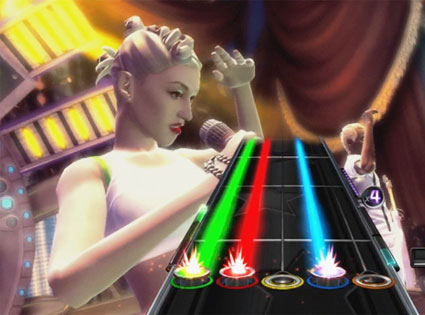
The sixth game in 2009 was “Band Hero”, which played pretty much identically to “Guitar Hero 5”, but with a different set list. These songs were aimed at an audience who liked softer music, pop rock if you will. Artists such as The Jackson 5, No Doubt, Taylor Swift and N.E.R.D. were featured. The game was met with a mixed reception due to the fact that it was pretty much “Guitar Hero 5 Lite”, and only had 65 tracks in comparison to the 85 tracks in the earlier game. Last but not least “Guitar Hero: Van Halen” was released, and was similar to the Aerosmith and Metallica homage’s.
Gwen Stefani of No Doubt in Band Hero.
At this point everyone had had enough of Guitar Hero. The sales waned, there were far too many games and the critics slated the makers for milking the product far too much. What needs to be remembered in all of this is the expense of the games as a fan and customer. The guitar and game bundles here in the UK are usually £50, or the band packs were usually around £150. So, if I were to get the band pack for £150, then each game would cost £30. So for just the main series, I could have easily have spent £400 in Guitar Hero games to get everything, if not more. It’s just stupid money for the average customer, and you need to remember, it was only four years ago at this point when the game series was created. Also, this was around the time where the credit crunch happened, which squeezed the pockets not just of the people of the UK, but the States as well. The critics were very harsh on the creators of Guitar Hero, making jokes and ripping them for asking too much from the fans, making too many games in succession. To be fair, they responded with announcing that they would reduce the number of games to be made in 2010.

And that they did, in 2010, the last year of the life of Guitar Hero, they only released two games. They released the final game in the main series, which was called “Guitar Hero: Warriors of Rock” and then “DJ Hero 2”. I want to briefly talk about DJ Hero 2, and say that once again, the game was well received. The main positive to take from the game was the even more diverse track listing on display, using artists such as Metallica, Lady Gaga, and Rihanna, artists not associated directly with rap and dance music.

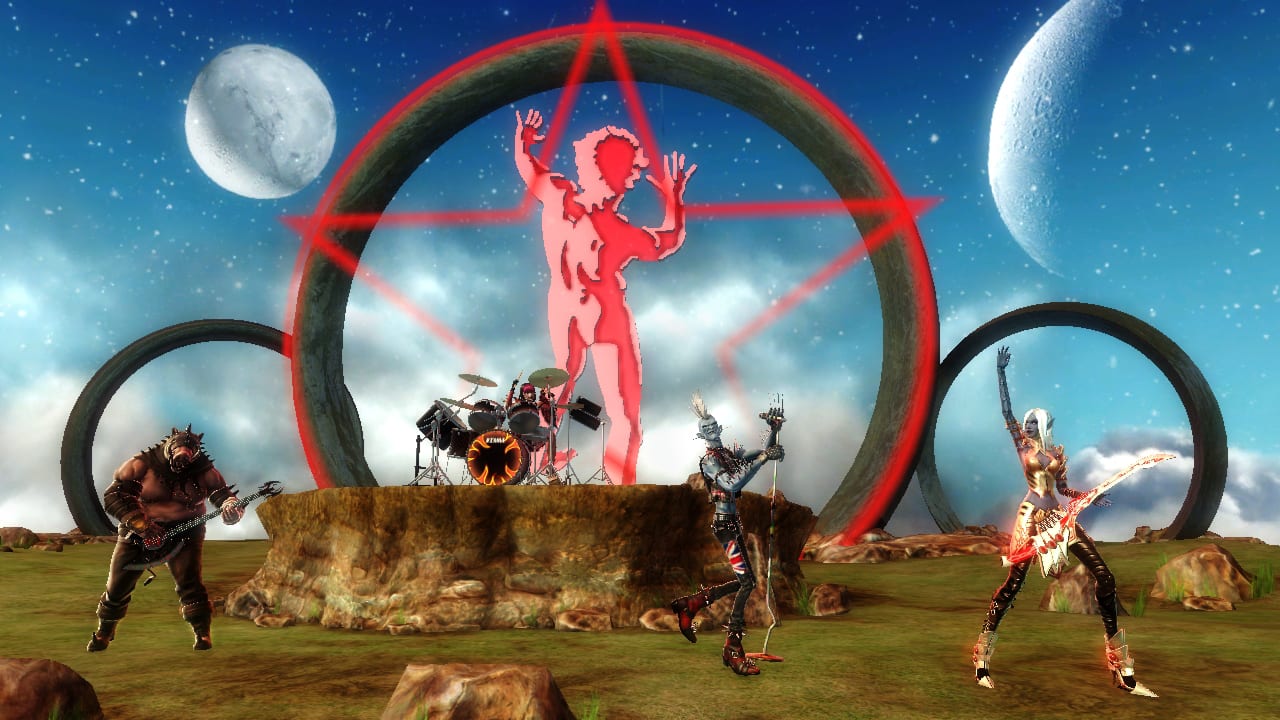
But the main final act for Guitar Hero was “Warriors of Rock”, which is also the most diverse of all the games. They wanted to distance themselves as much as possible from Rock Band whilst using the same peripherals, and changed the style of gameplay dramatically to achieve that goal.
Warriors of Rock features a lot of influence from Rush's 2112 album and song.
They did many changes, from things as subtle as adding yet another difficulty level in “Expert+”, although this was only used for the drums, where they introduced a double bass pedal.  Keeping with the theme of “Warriors of Rock” they redesigned all the characters in the game, giving them ‘warrior-esque’ looks and abilities. The career mode is replaced with “Quest” mode, where it is made possible to get much more than five stars for your song rating. In fact, it’s possible to get up to forty stars for each song. This is done by the ‘warrior’ star power abilities, which can do things like give you a six time multiplier for your star power rather than the original two, or by hitting a succession of note for an instant star gain. “Quest” mode puts you through all the songs, similar to the “Career” mode of old, but with added layers of story in a way never seen in the series so far. The story is narrated by Gene Simmons of KISS, where the player must save ‘the demi-god of Rock’ from a creature called “The Beast”, and the player must recruit eight more players to take on this creature. The players are basically the other characters from the game, who all have their signature styles and abilities. When recruited, these characters then turn into their ‘warrior’ guise, and are ready to take on The Beast. Without going into much more detail on the game, a lot of the latter parts revolve around the band Rush, and the ‘2112’ song, the logo and the ‘starman’ icon associated with it.

This new approach to the series was met with praise by critics, yet it did raise the concern that people who aren’t fans of Rush might not like the game much. It may have been a better idea to make this game “Guitar Hero: Rush”, although to concede, there are many other songs and artists featured in the game. Rush’s role in this game is purely for “Quest” mode, and there area total of 93 songs by 85 artists in the game otherwise, which more than makes up for anyone not interested in Rush.

Unfortunately for Neversoft and Activision, the game didn’t sell too well and it ended up being the final nail in the coffin of Guitar Hero. Activision in February 2011 announced that the series is on hiatus due to poor sales, although the way it was worded, it feels like it is indeed the end of Guitar Hero as we speak.
The many different Guitar Hero controllers through the years.
Guitar Hero barely if ever, produced a bad game. The series was consistently fun and that’s down to the great work done on the guitar controllers, and the decent selections of songs that were usually available. It wasn’t in the quality of gaming where Guitar Hero failed. The game series failed in the end because of greed. There was so much potential in the game series, but they wanted success, they wanted money, now. They wanted too much too soon, and it put off players and critics. The rise of Rock Band while not as successful financially as the Guitar Hero series, has still made over $1 billion in revenue, and a lot of these people who bought into that probably didn’t buy the Guitar Hero series afterwards, possibly because they couldn’t afford to or possibly because Rock Band maintained their reputation as a series who cares about fans. Keep in mind Activision released FIFTEEN titles in four years, where as Rock Band only released seven (the three main Rock Band titles with many downloadable tracks, a Lego game, and a homage to The Beatles, Green Day and Unplugged for the PSP). It was the pure greed and milking of the product that failed Guitar Hero, they never gave their fans enough time to take a breather from the series and maybe spend their money elsewhere. The decline in the music gaming marked at the turn of the decade approached, along with the credit crunch didn’t help, but Activision made their own grave unfortunately.

Maybe it’s not the end of the game series; hopefully they take a few years out and bring out a new title then. Let’s just hope there are enough people who are willing to buy either a new bundle or keep their old ones to show the interest. I know I will. I love and loved the Guitar Hero games. Like many people, I played it obsessively four or five years ago. But like many people, I grew out of it. I love video games in general and will play a variety of games. I have a wife and kid, and don’t earn a great deal of money, I can’t afford to buy every appliance Guitar Hero make, AND other games. But I have a lot of the games now, and I have two guitars. I’m going to upgrade to the Xbox 360 versions this Christmas, as I still have the PS2 originals. But I’m not going to play all the time, if not too often ever. Because I want to enjoy these games when I play them.

Guitar Hero has a place in my heart and it will never leave. Let’s give the series the round of applause it truly deserves, and remember the many, many good points the series gave us. If it’s truly gone forever, it will go down as one of the best video game series of all time, but it’s a story that I hope many other video game companies take heed of when thinking about their product, the audience, and the cost of video games.

I’ll be back tomorrow for the final part, the Mixtape, where I list my favourite songs to play in the game series. But for now that’s all from me, thanks for your time.

For the latest updates on my work, 'like' me on Facebook here!

Saturday, December 04, 2010

The Mercy Side: Gimmick and Shock Value in Music

I want to talk about something different today. I want to talk about shock value in music, and gimmicks. The most prominent term used in this field music wise is shock rock. Shock Rock is a bit of an ambiguity, some people use it as a genre label. It’s not. It’s using controversial elements, or visuals, in rock music. It’s not just used in rock music, it has, on a much rarer occasion, been used in pop music. There isn’t a coined term for it being used in pop music however.

Now I’m sure you’re wondering where I’m going with this. Well, I’m not going to tell you outright. I want you to just read on, if what I’ve been saying still interests you. I want to just talk about the history of this odd, well, label. I say label because as I said, it’s not a genre. It’s just a group of odds and sods thrown in from different genres.

Cue 1956. No, not Elvis Presley’s “Heartbreak Hotel”. But another singer also made a song. His name was Screamin’ Jay Hawkins. His song, “I Put a Spell on You”. It’s now considered one of the most important rock and roll songs in our history. Unfortunately for poor Jay, Nina Simone took the song and throttled it into the charts and made it her own. Many artists have also covered it, but no one more emphatically than good ol’ Nina.

Screamin’ Jay Hawkins was a complete badass. He did things no one had ever done before. He wore flashy outfits, leopard skin suits, leather, hats, he came out of coffins onstage, and he brought skulls and other voodoo related stuff on stage with him. He was a true pioneer of what is now considered “shock rock”. He was also a very good baby maker; some estimations say he has been responsible of around 55 children being born. Naughty bastard.

But how many of you know of him? I’ve known of him for a while, however I didn’t know a great deal. I knew, vaguely, he was responsible for such a cracker of a tune. I didn’t know anything else really, until recently. I want to get more from this artist, because, he just isn’t that popular. He deserves more recognition, he’s no where near as popular as someone else who is just as influential, namely Elvis Presley. Screamin’ Jay set the tone for so many artists, in his musical style, in his onstage persona. He was one fucked up dude, and unfortunately died around 10 years ago, and was a major drug user, but so are so many artists today, and in yesteryear. I’m not saying I condone that behaviour by the way.


So after “I Put a Spell on You”, he declined in popularity, in what wasn’t an extreme popularity in the first place. It’s not that his songs weren’t good, but that his act wasn’t getting any more attention. People were just more interested in Elvis Presley, and the boom of rock ‘n’ roll rather than some weird dude wearing weird stuff with smoke coming out of his pet skull. But some people did take note, and were influenced by this estranged man.

Cue 1964. A very young 16 year old man named Vincent Damon Furnier started a band. He couldn’t play any instruments. Neither could they. But they dressed themselves up as The Beatles and won a competition, regardless of their talentless and mimed display. This inspired Master Furnier to start a proper band. The called themselves The Spiders and played with a huge spiders web in the background. They changed their name to The Nazz afterwards, but there was already a band called Nazz. Four years after debuting as The Spiders, in 1968, they decided that they needed to work on their gimmick a bit more, come up with a better name and be more outrageous. They decided to name the band Alice Cooper, which would also be the name of the lead singer.

They toured with another band, a girlband, named GTO’s who dressed them up in makeup. They had the image, but they didn’t have the controversy. In September 1969, a chicken appeared on stage out of nowhere. Poor Alice , thinking chickens had wings and therefore could fly, threw it above the crowd. It plummeted into the first few rows and the crowd decided to tear the chicken to shreds. This made national press, across front pages. This publicity, and the moving to Detroit where people liked the sound of their music more, got them more popular.

In the early seventies their music got more popular, and their stage antics stood out more, around this time a lot of the bands were post rock ‘n’ roll/pre glam rock hippy bands, so, along with Black Sabbath, Alice Cooper was a unique gig. In ’72, out came School’s Out, which hit the UK charts at #1 and the album of the same name did fantastically well too. Alice Cooper was finally towards the top of the world, they released a few albums in succession which were commercial successes.

 
On stage in these years, the gimmick and shock rock shows were really starting to be full of fuel. Electric chairs, snakes, axes, toy babies with blood, and execution, dentists are all common themes that have been associated during this time. But the real cracker, was the decapitation of Alice Cooper, live on stage. Nothing had ever been done like that before, and none more successful since.

The tours and problems within the band took its toll in ’74 and they decided to take a hiatus. Alice Cooper performed as a solo act from this time onwards, but he has never really found any consistent success since then. He had a good re-emergence in ’89 with his hit “Poison”, but he has largely been seen has a cult act from the seventies, rather than a music legend, which is a shame, because, like Screamin’ Jay, Alice hasn’t received the consistent reception as a musician and a “shock rocker” as he should have been.

Cue 1971, a few years before Alice Cooper’s band was put on hiatus. A band was formed named Wicked Lester, who weren’t very popular. They released one album that was shelved, and two of it’s members decided it was a good idea to maybe start afresh with a new approach. They got a new drummer and a new guitarist, and decided to take a hard rock approach to their music. They decided to gimmick their band after comics, and gave all the band members names. They started wearing makeup and outfits, inspired by the surge of Alice Cooper. The makeup they used would be in relation to each character they pretended to be. Two years after Wicked Lester was originally formed, they changed their name to Kiss.

The stunts Kiss would do on stage was firebreathing, vomiting blood, playing a guitar on fire, emitted sparks on the drum kits, and many pyrotechnics. Kiss weren’t getting anywhere fast with their albums, but their live shows were eye catching and memorable. It was only until they released a double live album, two years after, in ’75,  that they got a lot of attention.

After the double album release they had a fantastic period between ’75 and ’78 where they released many platinum albums. Unfortunately in ’78, they went overboard, released four “solo” albums on the same day, and released an awful film where they were superheroes. Since then, they haven’t really been the same. They had a decent hit with the follow up album in ’79, but their album sales declined. Kiss’ live shows started off and still is the biggest attraction, as well as their image. Kiss’ cult following in it’s three year peak was unstoppable. But never were Kiss consistent, and never did they get another boom.

Cue 1989. Some young journalist in Florida had a respectable break when he started to interview bands of decent standing, the biggest being Trent Reznor of Nine Inch Nails. This bloke ended up meeting another bloke started writing poems and lyrics, and decided, hey, let’s make a band!

So they did. Using Kiss’ approach to band making, they decided to have names for each member as well, only this time instead of names based on comic book characters, they mixed together good and evil, by having murderers names attached to famous females.

We had Olivia Newton Bundy, named after Olivia Newton John and Ted Bundy, the singer and serial killer, respectively. We also had Daisy Berkowitz, named after Daisy Duke, the character from Dukes of Hazard, and David Berkowitz, another serial killer. We had Madonna Wayne Gacy, named after pop singer Madonna, and again, serial killer John Wayne Gacy. Finally, two years later, we had Sara Lee Lucas, named after the food company Sara Lee, and Henry Lee Lucas, another serial killer.

The above formed The Spooky Kids, but that journalist we were talking about in the start? Well, he was the lead singer, he also had a name, one you’re more familiar with. He decided to call himself after Marilyn Monroe, and Charles Manson. Yes, he is Marilyn Manson.

Marilyn Manson went right off the bat and played gigs in their local area and got a quick cult following for their controversial shows. They had naked women on crosses on stage, a kid in a cage, animal parts, they wore women’s clothing, to go with their female names. They didn’t have money so instead of pyros they just set things on fire. Then in ’93, the man that Manson interviewed four years ago, Trent Reznor, picked up this band and gave them a record deal. Reznor helped their sound as a band, because without him, Manson was just a live gig, similar to Kiss, just on a smaller scale. He helped them release three albums between ’94 and ’98, with each getting more and more popular. Around this time Manson started experimenting with outfits, using more gothic style make up, also donning corsets rather than long white dresses. This change in image and improvement in music ability came to a major climax in ’96, when the release of metal anthem “The Beautiful People” got them worldwide fame.

The album that this metal anthem was released on, “Antichrist Superstar”, was full of anti-God related lyrics. Bands had used anti-religion in the past, but none anywhere near as successfully and controversially as Manson. Many church goers and churches would petition for their cities to ban Manson from gigging. The more anti-Manson Christianity became, the more anti-God Manson became, and the more publicity he got, the more popular he was.

After the release of his fourth album in 2000, Manson really dropped in popularity. His shows became stale; his music was becoming less popular. Falling out with Trent Reznor didn’t help, as he was the pioneer behind the music of the band. Manson had followed a similar road that his idols Kiss and Alice Cooper found, a boom period, then it blowing up in his face.

Which brings me to the main point in this article – Lady Gaga. What, you don’t understand why I’m mentioning her? Well look at the small profiles I mentioned above. Lady Gaga is in the same category, just singing a different genre. She is shock value, she’s not shock rock, she’s not a rock musician, but she is shock value. From Screamin’ Jay, to Alice Cooper, to Kiss, to Marilyn Manson, she is paving the way, using shock value and imagery to captivate millions of fans. She doesn’t mention any of these artists as her main inspiration, not one. But she is definitely inspired by ALL of these artists.

Screamin’ Jay Hawkins. He wore flashy outfits; he was one of the establishers of the flashy outfit stage persona. Alice Cooper, the pioneer of major stage stunts. Lady Gaga recently pretended to be shot on stage in a white dress, which slowly turned blood red where the “shot wound” was. Kiss was the epitome of pyrotechnics and flashy stage props. Marilyn Manson used controversy to get where he is today, Manson wore corsets and cut his chest open on stage, Lady Gaga decides she wants to wear raw meat. Also like Manson, she chose her name based on a famous song, Manson did the same just with people.

Lady Gaga mentions David Bowie, Queen, Michael Jackson and Madonna as her main inspirations. Fine. But unlike those four, these people have had boom periods, and then failed. These four, were consistent, were global icons, and will be remembered in history. The four I talk about in good detail  are merely going to become footnotes in comparison.

Now I want to set the record straight. I don’t like Lady Gaga’s music. It’s not my thing. But I do respect her. I think she has something that not many artists have today. She’s actually a very intelligent woman. She’s wrote lyrics for many artists in her genre, before people knew who the heck she was. Then she thought, “fuck it, I’m good enough to do this myself”. She can sing, she can play instruments, she is talented. What separates her from everyone, and I do mean everyone, in her genre is that she is using shock value in her music. She is creating shock pop, basically. No one since Madonna has been able to do it, and you know something, she could surpass Madonna, if she uses her talents well enough.

And that’s a big if. The likelihood is that she will actually follow the same route as the others, she is having a boom period, but then she will depend on shock value, and lose popularity. There’s shock value, then there’s consistency. You can only shock someone by doing something once, you do it over and over again people aren’t going to be shocked. The artists above did just that. They tried the same trick two or three times, they all had different amounts of success doing it, and then declined into mediocrity.

Gaga is playing her trick on a much larger scale also. The artists I mentioned weren’t playing to a pop audience, but to a rock audience. Especially since the seventies, the divide between a rock and pop audience is more than apparent. More people like pop music, it’s a simple divide as that. If she fucks up, she will fall down from grace much harder than everyone else. Madonna, and in some ways, Kylie Minogue, are the only artists that have really had good consistency, in some ways you may include Britney Spears in that list, maybe. So yes she could be the next Madonna.

The could be the next Madonna, or, she could be the next Darkness. Yes I said it, The Darkness. Remember those? They had a similar vein of form, yes they were a rock band, but they were playing pop tunes with rock instruments. They had a brilliant time touring and selling their first album, with their Kiss and Queen inspired sets. They were shot up to the stars, and thought they would do the same with their second album. Remember that? Not many people do, actually. What was the third single of that album? I don’t know, let me check Wikipedia… hang on… there it is! It was Girlfriend! What a track!

To conclude, I wanted to get this off my chest because it’s an intriguing situation. If you use a gimmick, or shock value in music, there’s only so much you can do with it. This is after all, music. Imagery, stunts, pyrotechnics, imagination, can only get you so far, if you’re not talented or diverse enough in the music business, you can get put down quickly. Madonna has shown she is diverse enough, she used controversy, she used sex, and she is now using her “MILF” status. But she is diverse enough as a musician, and talented enough to span a career across four decades. David Bowie changed his persona many times, but he also backed it up with the music, he is one of the most important musicians in history. But Manson, Hawkins and Cooper haven’t been anywhere near as successful because they weren’t diverse enough and depended on their shock rock personas.

Lady Gaga is releasing her second album next year. Will she be able to use her talents, as well as her shock value, to continue on? Will she follow The Darkness, or Madonna? We shall find out, won’t we!
 
For the latest updates on my work, follow me on Facebook and Twitter here!